Skip to content


The best front door colors for 2026 are warm, grounded, nature-leaning shades — deep navy, soft sage, warm putty, and blacks with real depth. A front door is a small surface that carries a lot of weight, the first thing a guest sees and the last thing you touch on your way out, so these calm, settled colors do a lot with a little.
What changed this year is the mood. The front door color trends for 2026 have moved away from bright, attention-grabbing hues toward colors that look like they’ve always belonged on the house. A few also do real work for a home’s value, and some pair far better with certain exteriors than others. Here’s what each looks like on a real house, and how to tell which suits yours.
Key Takeaways
Navy, black, and deep green are the safest and most flattering front door colors for 2026, and they work across nearly every home style. Warmer choices like classic red and warm putty feel current on brick, stone, and shingle, and the right dark neutral can add real resale value. The color that looks best is almost always the one that matches your home’s fixed materials and the light at your entry.
The Front Door Colors People Are Choosing in 2026
The most popular front door colors for 2026 are deep, nature-based shades: navy blue, forest and sage green, warm black, and earthy reds. The common thread is calm — colors that feel rooted in the house instead of layered on top.
The paint companies agree. The broader 2026 exterior paint color trends lean toward soft, cloud-like whites from Pantone and grounded neutrals from Sherwin-Williams like khaki, greige, and mushroom. On a door, it all reads as quiet luxury — expensive-looking without trying.
Navy Blue Front Doors
Navy blue is the standout front door color for 2026 because it behaves like a neutral while still adding real color. It sits comfortably on colonials, craftsman bungalows, farmhouses, and modern builds alike.
Good options include Benjamin Moore’s Hale Navy (HC-154), Sherwin-Williams’ Naval (SW 6244), and Farrow & Ball’s Hague Blue (No. 30). The best part is how navy moves through the day — almost black on an overcast morning, then clearly blue when the sun hits. It pairs beautifully with white trim, red brick, and gray siding.
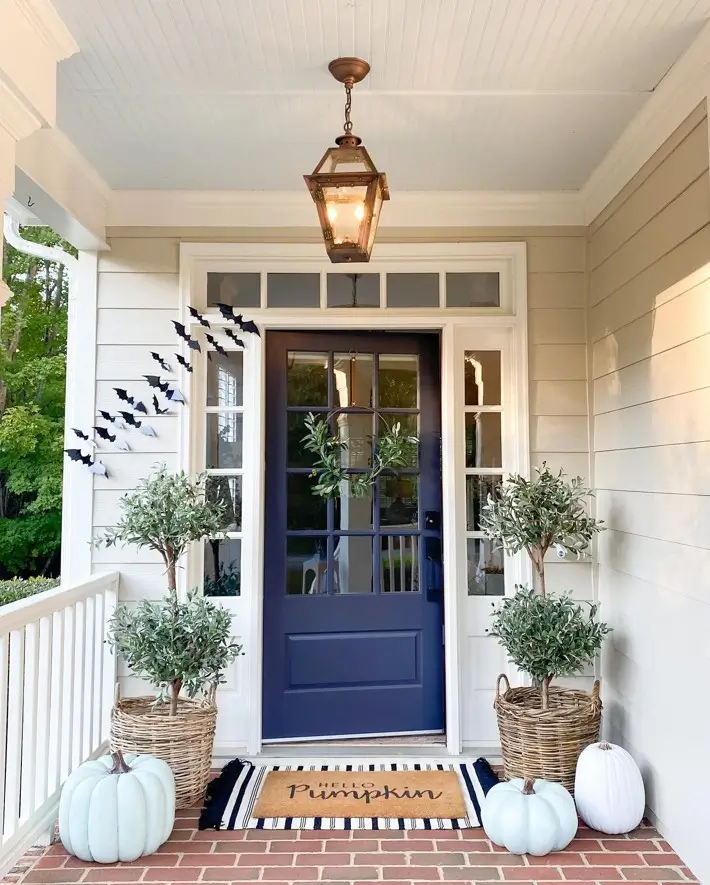
Glass panes fill this navy door, so the deep color frames the daylight instead of shutting it out. Cream siding and white trim keep everything crisp, while olive topiaries in wicker baskets and a warm brass lantern soften the entry. It feels lived-in and quietly put-together.
Black and Charcoal Front Doors
A black front door is the most versatile choice of all, pairing cleanly with almost every exterior color and style.
Sherwin-Williams gives you three to land on, and LRV — how much light a color bounces back, lower being darker — sorts them. Iron Ore (SW 7069, LRV 6) is a soft near-black charcoal with a green whisper; Peppercorn (SW 7674, LRV 10) is a lighter, neutral charcoal; and Tricorn Black (SW 6258) (LRV 3) is the true black for a sharp, modern door — the near-blacks that anchor these black house exterior ideas. One caution: a black door in full sun gets hot and can fade or crack sooner, so a heat-reflective exterior paint helps it last.
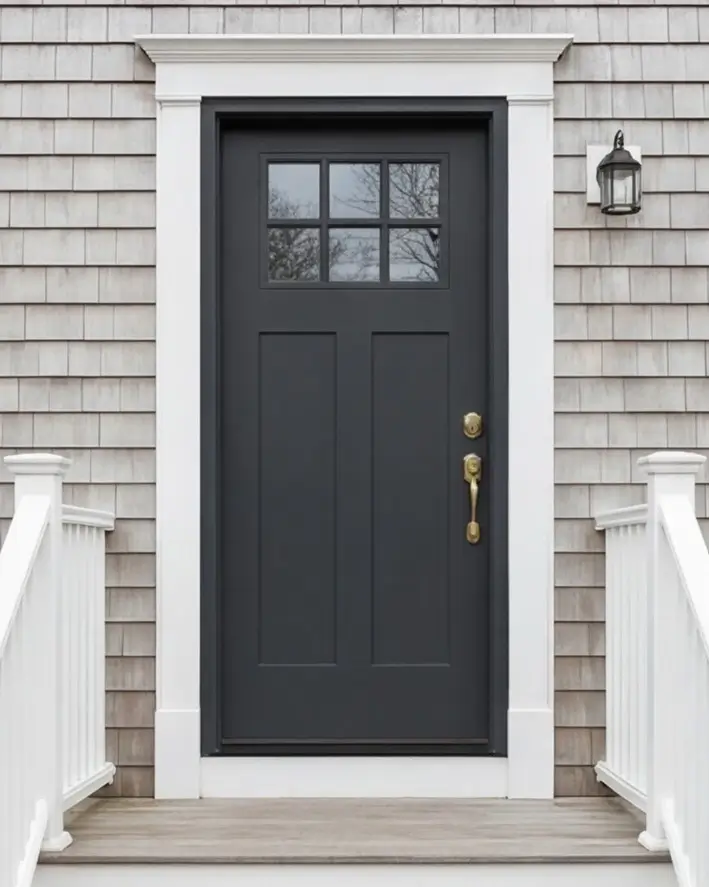
Six small panes sit at the top of this charcoal craftsman door, catching the bare trees behind you. Crisp white trim and weathered cedar shingles let the dark color read soft rather than stark, and the brass handleset adds a little warmth. Understated, and quietly confident.
Green Front Doors — Sage, Olive, and Forest
Green front doors are having a real moment in 2026, especially soft sage, muted olive, and deep forest tones. Green has quietly become the new neutral, blending with the landscaping already around the door.
Sherwin-Williams’ Pewter Green (SW 6208), Benjamin Moore’s Georgian Green (HC-115), and Farrow & Ball’s Green Smoke (No. 47) are safe places to start, and softer sage shades scale up beautifully across these sage green house exterior ideas. A muted green reads almost gray at dusk, then comes alive when the sun lands on it — lovely against stone, warm brick, and cream trim.
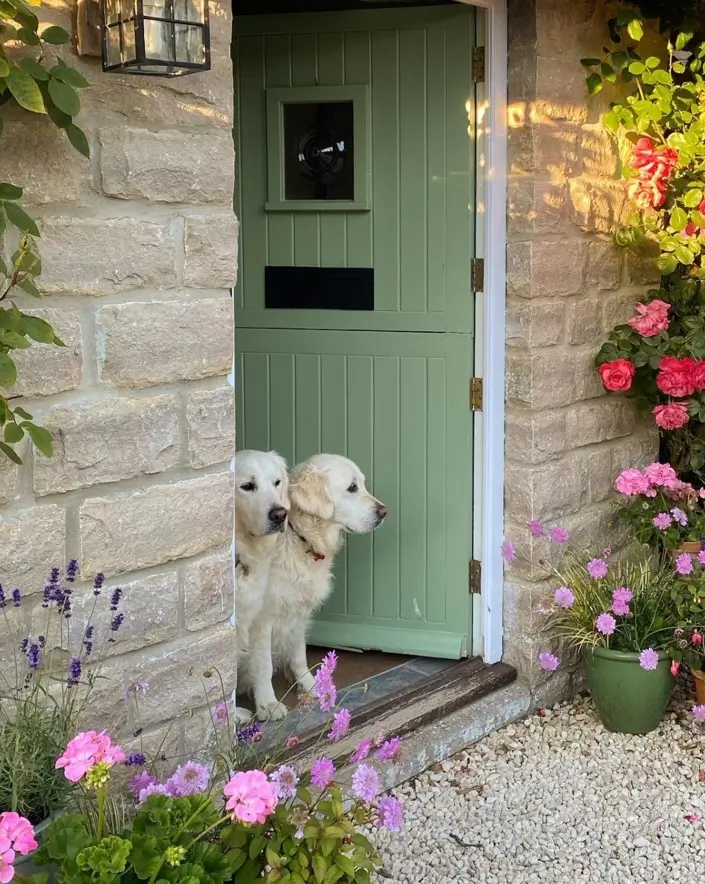
Sage green settles perfectly into this stone cottage, its plank stable door split so the top can swing open on its own. Roses, lavender, and geraniums crowd the entry, and two golden retrievers wait in the doorway. Everything here feels soft, sun-warmed, and genuinely welcoming.
Classic Red Door
Red front doors range from a crisp, classic true red to earthier terracotta and burnt-umber shades, and both feel right for 2026.
Red has one trick no other color offers: it makes it obvious where the front door is, which helps on a busy facade. Benjamin Moore’s Caliente (AF-290) is a clean classic red; a clay or terracotta tone gives the same warmth, softer. Just skip a very glossy, fire-engine red — a slightly muted version wears better over the years.
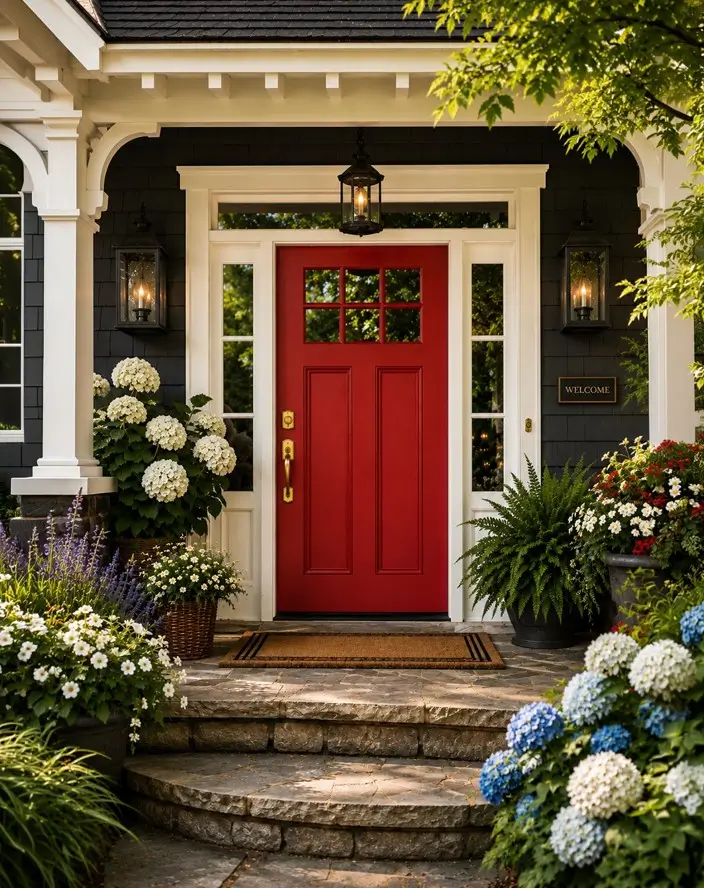
Bright true red gives this craftsman door real presence against dark shingles and white trim. The six-pane top and brass handleset keep it classic, while white and blue hydrangeas soften the stone steps. You can spot the entrance from the street in a second.
Neutrals — Greige, Putty, and Warm White
Warm neutrals like greige, putty, and creamy white are the quiet-luxury front door colors of 2026 — they don’t shout, and that’s the point.
Farrow & Ball’s White Tie (No. 2002) and Benjamin Moore’s White Dove (OC-17) are soft creams that avoid going too yellow, and darker or brass hardware keeps a pale door from feeling flat. One honest note: a pale door needs good contrast around it or it disappears — on some styles, like these modern Tudor exteriors, a white door is a wasted accent altogether. It can, though, make a small home feel a little larger.
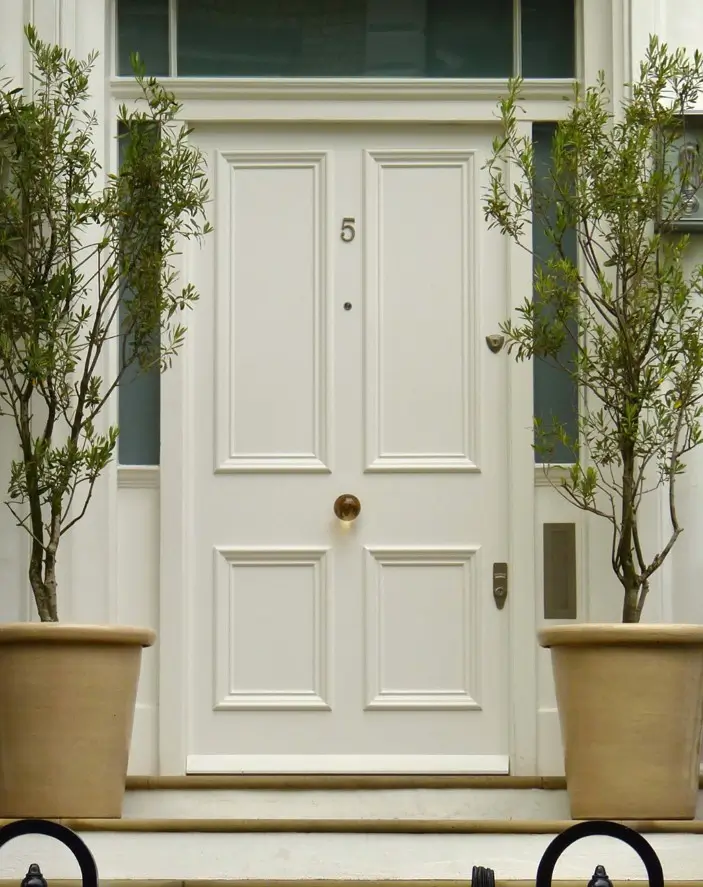
Warm off-white keeps this paneled townhouse door calm and refined, with a brass center knob and a simple house number as the only detail. Matching olive trees in terracotta pots frame it evenly. The whole entrance feels composed, the kind you slow down to admire.
Best Front Door Colors for Red Brick Houses
The best front door colors for red brick houses are the ones that cool the brick’s warmth: navy, deep green, warm black, and espresso.
Pull your undertone from the brick itself — it helps to know what colors go with red brick more broadly. Warm red brick loves warm black, deep forest green, or espresso; orange-toned brick is fussier, so lean blue-green or true black. Avoid a bright red door against red brick — the two reds compete and the door loses its outline.
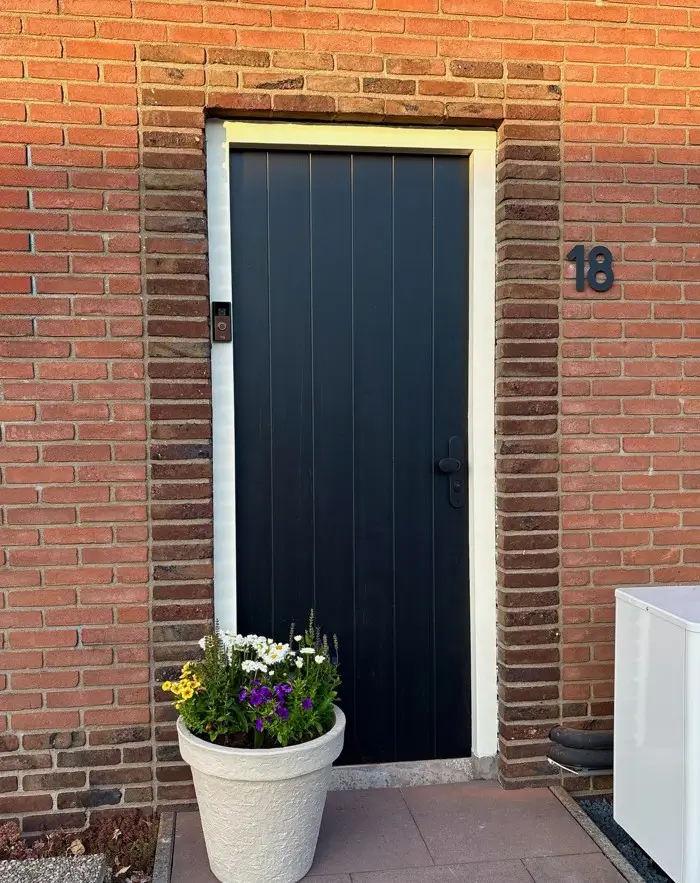
Deep near-black cools the warm orange tones of this red brick beautifully, and the pale surround gives the dark plank door a clean edge. Black hardware keeps it modern, while a stone pot of white and purple blooms lifts the entry. Proof that dark reads sharp on brick.
Best Front Door Colors for Gray and White Houses
The best front door colors for gray and white houses are the deep, confident ones — black, navy, and charcoal — since a light exterior turns almost any dark door into a clean statement.
A matte black door is the surest bet: crisp on white or cool gray, still standing out but gentler on cream or stucco. Cooler grays also pair with charcoal and muted blue-greens, and a white farmhouse can carry sage or muted blue as easily as black. On a light house, the door gets to be the moment — so pick the depth you want noticed first.
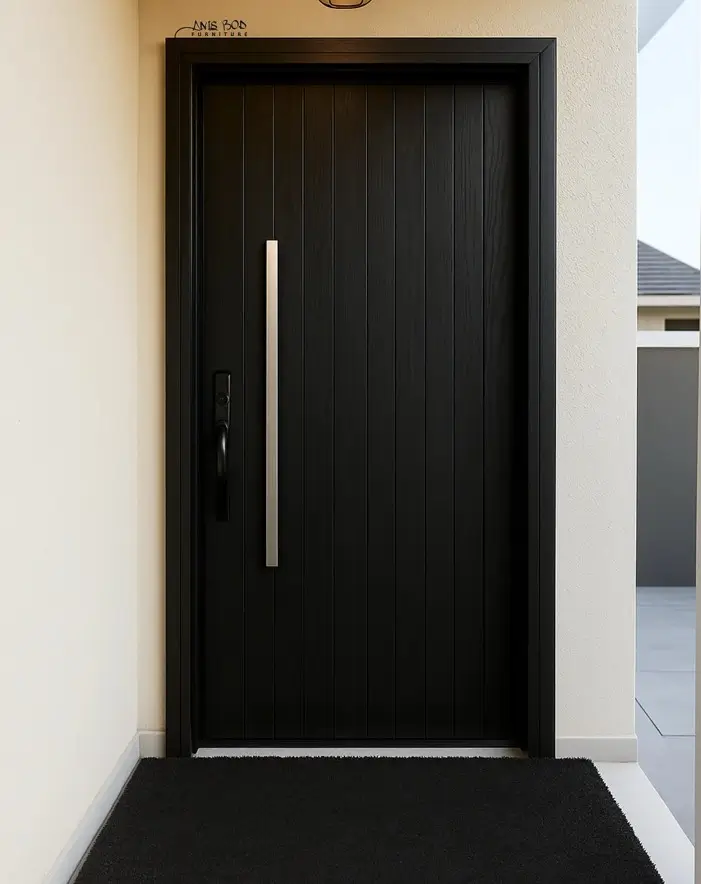
Matte black turns this modern plank door into the whole statement, its long brushed-steel pull running nearly floor to ceiling. Warm cream stucco keeps the contrast gentle instead of harsh, and the clean frame feels current. Simple, bold, and unmistakably now.
Front Door Colors That Add Curb Appeal and Resale Value
The front door colors that add the most curb appeal and resale value are dark neutrals: black, charcoal, and navy blue — a bold door is often the highest-impact update on a facade, as it is across these modern ranch exterior ideas.
A widely cited 2022 Zillow study found buyers would pay an estimated $6,449 more for a home with a black front door, with slate-blue scoring highest overall. That figure is a few years old, so treat it as a direction — but the pattern holds in 2026: dark neutrals photograph best and appeal to the most buyers. One money-saver: a color always looks darker installed than on the chip, so sample it on a board against the house first.
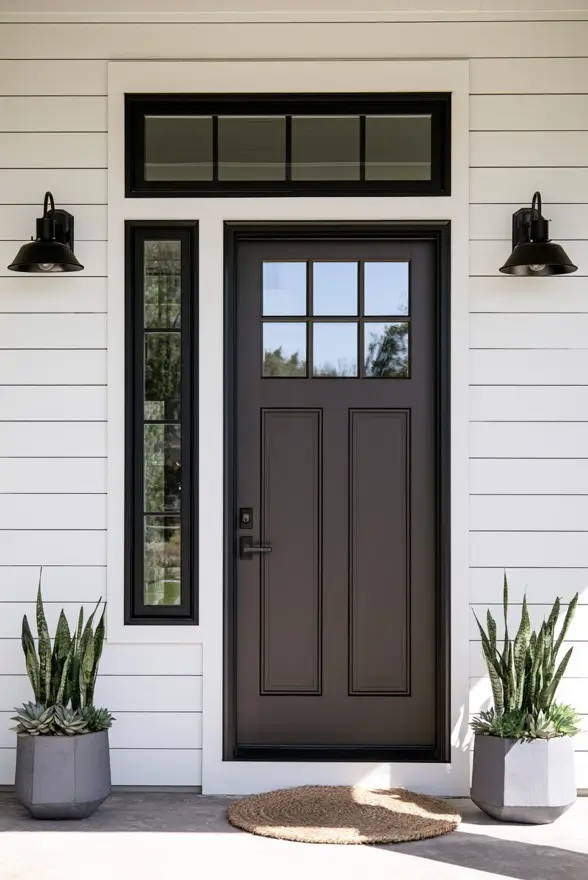
Deep espresso-brown reads almost black on this craftsman door, sharp against white siding and matching black sconces. Six panes up top, snake plants in gray pots either side, and a round jute mat keep it clean and symmetrical. This is the kind of entry that photographs well from the street.
How Light and Direction Change Your Door Color
The same front door color can look completely different depending on how much light your entry gets and which way it faces.
A deep porch wants a lighter or brighter color; an open, sunny entry can take darker shades that would wash out in shade. Before buying a gallon, live with a sample — morning, midday, and evening — then check it from the sidewalk, because curb appeal is judged at a distance.
How to Choose a Front Door Color
Choosing a front door color gets easier in order, and it takes a single afternoon. Start with the rules: if you’re in an HOA, check for approved-color lists before you fall for a shade. Then look at the house as a whole — read the siding, roof, and any brick or stone, and picture your top colors against all of it. Hold each option against the things that aren’t changing — window frames, shutters, garage door — and keep the one that plays nicely with the group. Starting fresh? Ask what personality you want the house to give off — classic and calm, warm and welcoming, or bold and modern — and let that point you.
Frequently Asked Questions
Should a front door be lighter or darker than the house? A front door usually looks best a few shades darker than the house, since a contrasting accent draws the eye to the entrance. The exception is a minimalist or small home, where letting the door blend softly into the exterior can make the whole front feel calmer and a bit larger.
Should the front door match the shutters or the trim? A front door generally looks best in a color that contrasts with the trim rather than matching it, since matching trim can make the door disappear. Coordinating loosely with the shutters is fine, but the door and trim usually want to be different colors.
What paint finish works best on a front door? A satin or semi-gloss finish works best on a front door because it stands up to weather, wipes clean easily, and gives the color a subtle richness. Flat finishes show wear faster, and a very high gloss highlights every small dent.
How long does a painted front door last before it needs redoing? A well-painted front door typically holds up for five to eight years before it needs a refresh, though a sun-facing or dark-colored door often fades sooner. Uncovered entries and deep colors take the most abuse.
What is the best front door color for a north-facing entry? A north-facing front door does best in a warm or slightly brighter color, since north light is cool and can make deep, dark shades feel dull. Warm reds, soft greens, and creamy neutrals tend to feel more welcoming there than a cool charcoal or a heavy black.