Skip to content


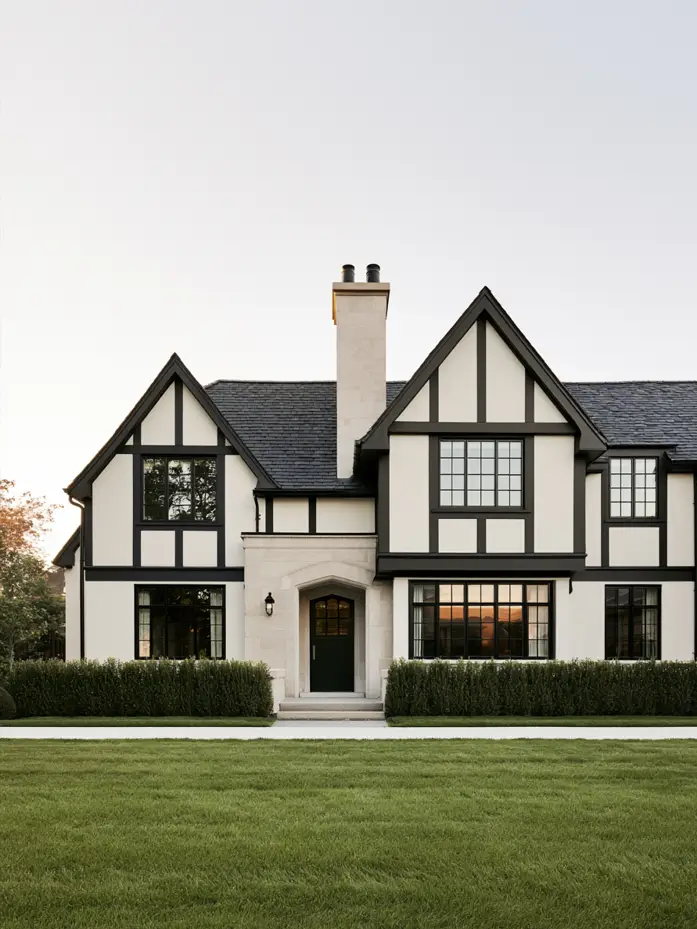
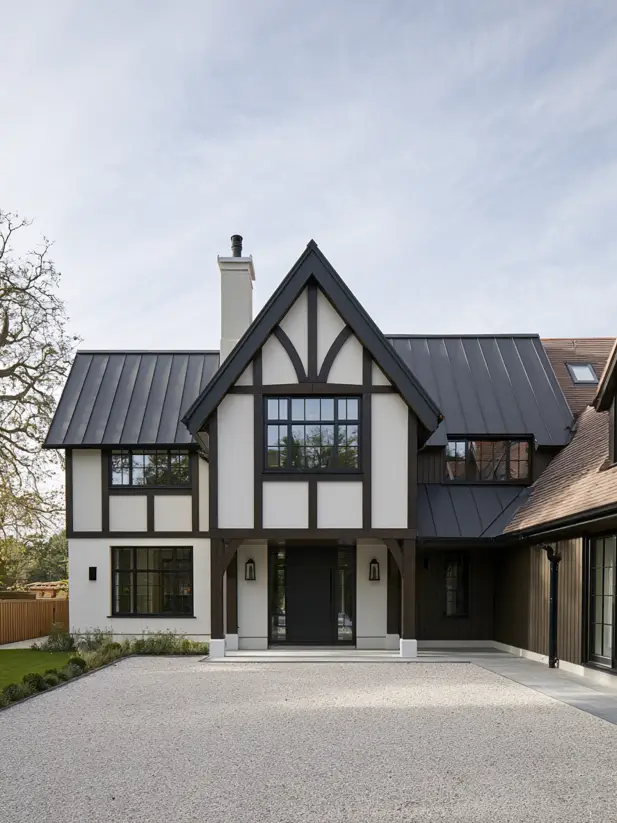
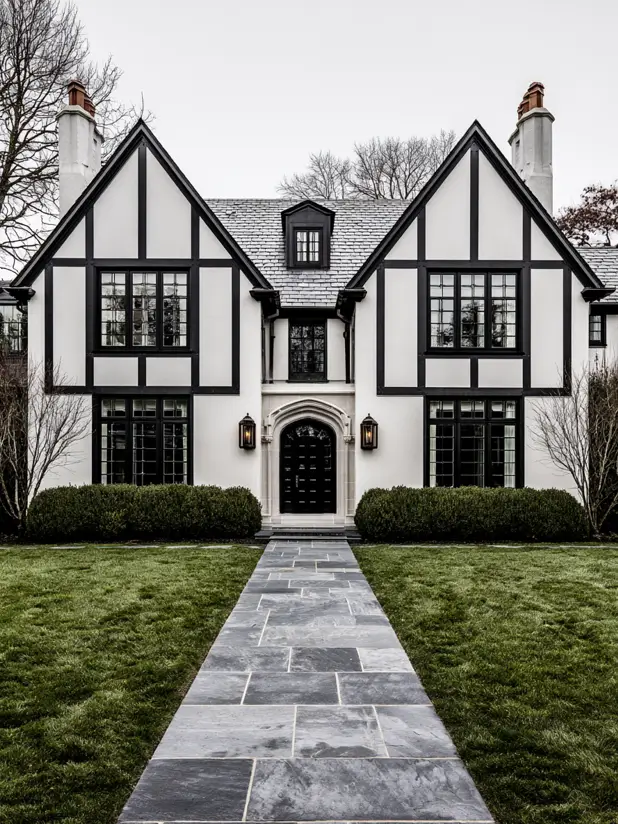
A modern Tudor exterior keeps the steep gables, the arched entry, and the asymmetrical massing, then updates everything else: black steel windows replace small leaded casements, dark brick is limewashed or painted, and heavy brown half-timbering is reduced to a restrained charcoal accent. The silhouette stays. The palette lightens. That is the whole formula.
Tudor is having a real moment in 2026. After a decade of modern farmhouse and coastal grey, buyers have moved back toward character, and 1920s–40s Tudor stock sits in a sweet spot: generous square footage, distinctive facades, walkable pre-war neighbourhoods, and floor plans flexible enough to modernize. There are a lot of them — during the 1920s boom, roughly a quarter of new American homes were built in the style, earning the grander examples the nickname “Stockbroker Tudors.”
But modernizing a Tudor is easy to get wrong, and the cost of getting it wrong is measurable. Classic Architecture Today puts it bluntly: a Tudor Revival loses much of its value when renovated into something generic, because the buyers paying premium prices are specifically seeking authenticity.
So this guide is organised around a single principle — Below are 32 changes that work, with the paint colours designers actually specified on real projects, the construction detail that keeps them from rotting, and what each one costs.
The 70/30 Rule
The balance designers aim for in 2026 is roughly 70% preserved exterior, 30% modernized facade detail — window frames, lighting, and colour. Get that ratio backwards and you’ve built a generic house with a pointy roof.
The five things you never change: the steep roof pitch (typically 45°+, the strongest Tudor signal); asymmetrical massing (overlapping front gables at varying heights); the prominent chimney (massive, worn on the outside); the arched, off-centre entry; and real material variety (brick, stone, and stucco meeting on one facade).
The five things you should change: the windows (small dark leaded casements date a Tudor fastest); the colour (orange-brown stucco and chocolate timbers are the 1970s speaking); the timber density (American half-timbering was decorative, so reducing it is honest); the lighting (one sad porch light is standard); and the landscaping (overgrown yews hide the brickwork you’re trying to show off).
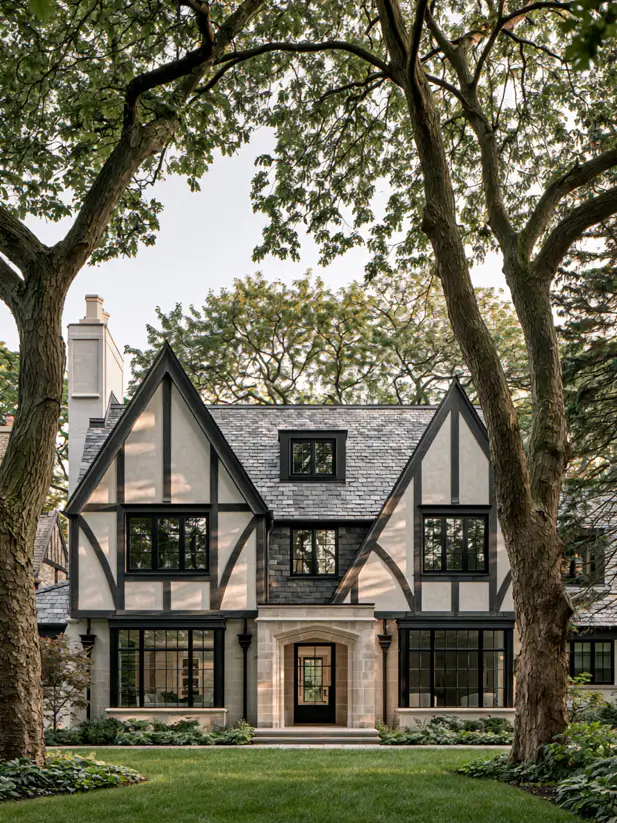
Before you touch anything. If your Tudor sits in a historic district — and many do, in places like Ditmas Park in Brooklyn, Beverly in Chicago, Brookline outside Boston, or Pasadena — changes to windows, roofing, and especially half-timbering typically need commission approval. Unpermitted work can mean fines and forced removal of finished work. It’s one phone call.
Black Windows and Modern Glazing
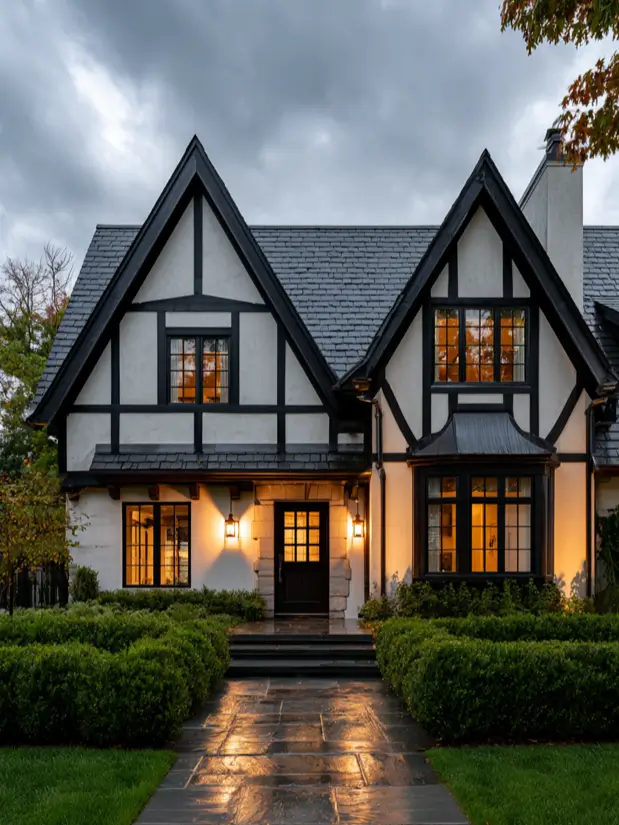
This is the defining move. If you make one change, make this one. Black frames sharpen every opening on a pale facade and tie the glass to the dark roofline above — and unlike most renovations, the effect is visible from the street immediately.
1. Swap leaded casements for slim black steel
Slim-profile steel or aluminium with true divided lites keeps the Tudor rhythm while ending the dark, closed-in look. Budget $800–$1,500 per window installed for quality units.
2. Enlarge the ground floor glazing
Tudor ground floors were built dark. Widening the main living room opening into a picture window or steel-framed wall is the biggest liveability upgrade available, and the steep gables above absorb the contrast easily.
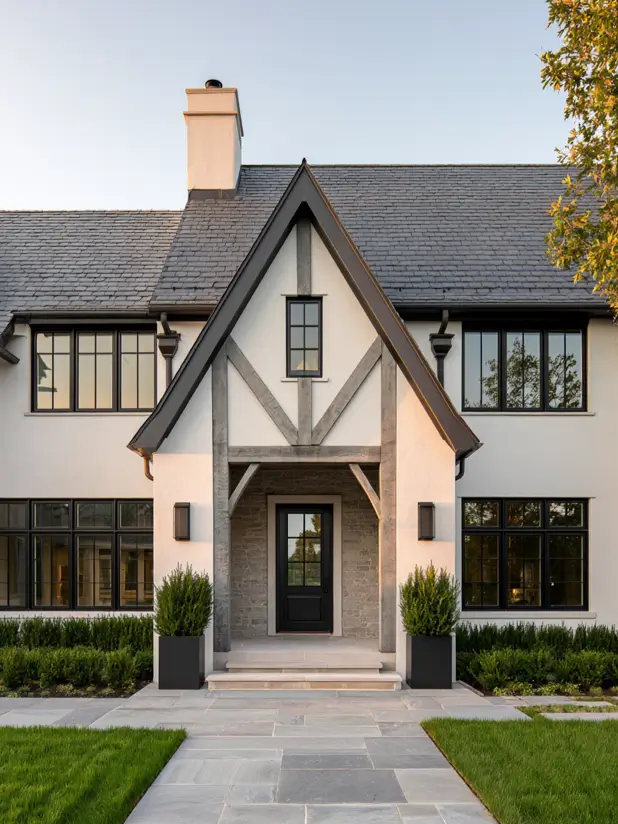
3. Keep every arch arched — and consider bronze frames
Where you have an arched opening, replace with an arched unit; squaring off a Tudor arch to save money is visible forever. On Tudors with warm red brick or honey stone, dark bronze frames hold the same graphic weight as black while picking up the masonry warmth.
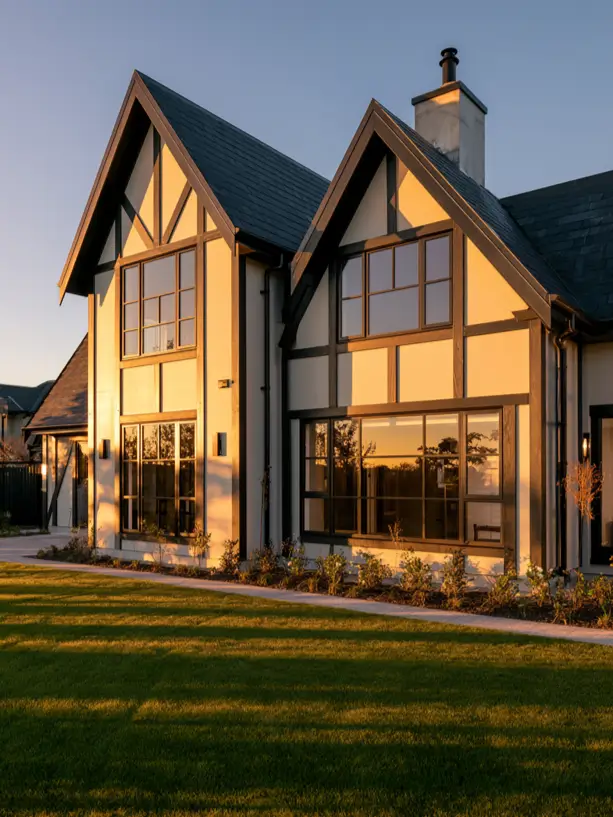
4. Or just repaint the frames
If your windows still function, painting the frames matte black delivers most of the visible change for a fraction of replacement cost. In remodeling cost-versus-value data, window replacement returns less than door and cladding projects — so if budget is tight, paint first and spend the money where it works harder.
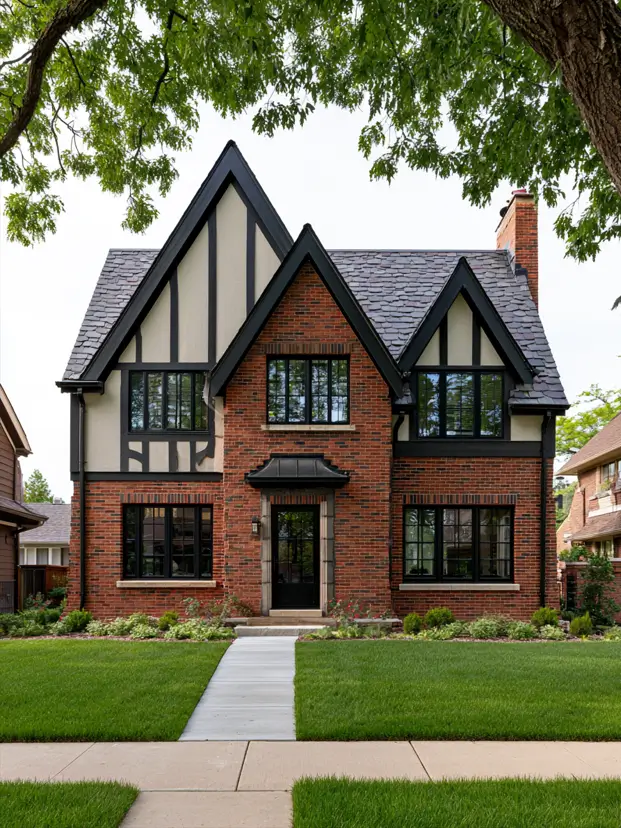
Limewashed and Painted Brick
Dark red brick is what makes most Tudors read heavy and dated. Four options, in ascending order of permanence.
5. Mortar wash or German smear
Thinned mortar dragged across the brick leaves a warm haze with the original colour showing through — the most forgiving option. A thicker application gives you the heavier old-world German-smear texture. Neither fully hides the brick, which is the point.
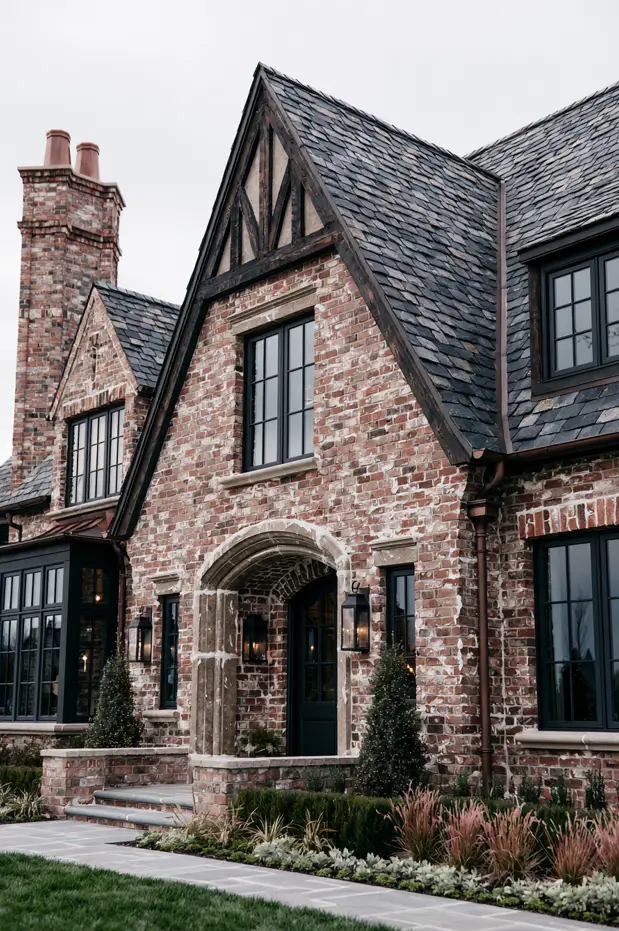
6. Limewash
Breathable, ages beautifully, and can be partially removed within a few days of application. Uneven coverage is the point, not a flaw. Expect $2–$5 per square foot DIY, $3–$7 professionally.
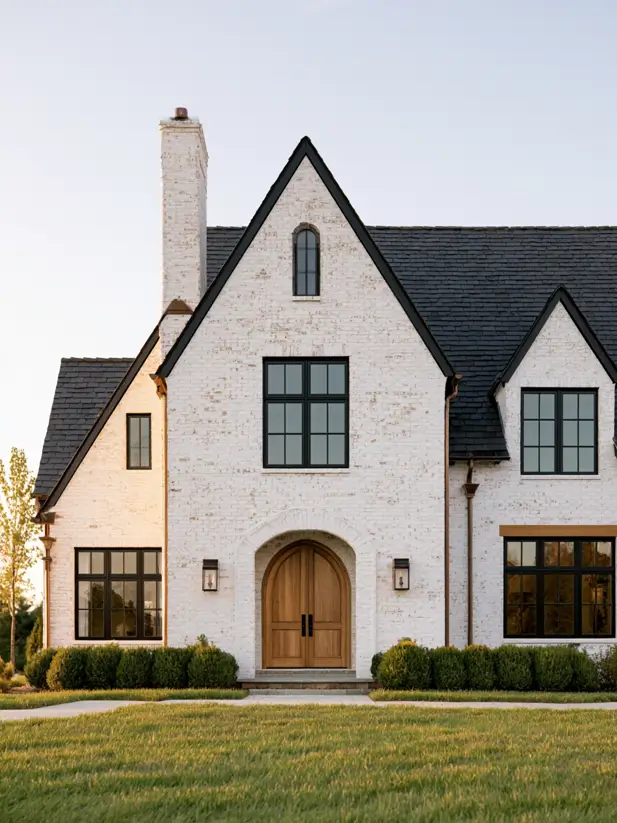
7. Full paint — and match it to the stucco
Permanent, needs redoing every 7–10 years, but transformative. One designer approach on a large Tudor was to paint the brick the same colour as the stucco in Benjamin Moore Seapearl, dropping the contrast so the only remaining contrast is the half-timbering, the copper awnings, and the structure itself.
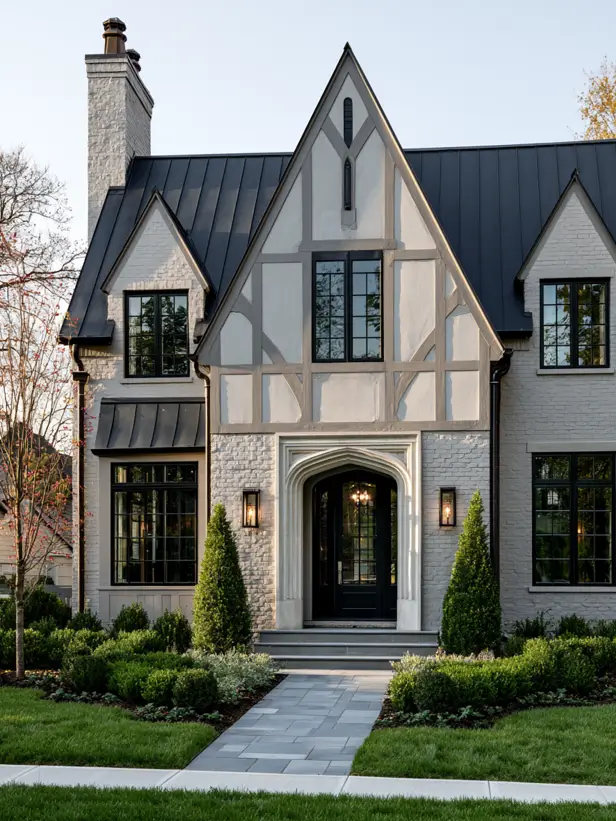
8. Or leave it alone
If your brick is a warm handsome red with sound mortar, keep it and modernize around it — new black windows, new roof, new door. Painting good brick is the single most common regret in this category, and it’s irreversible.
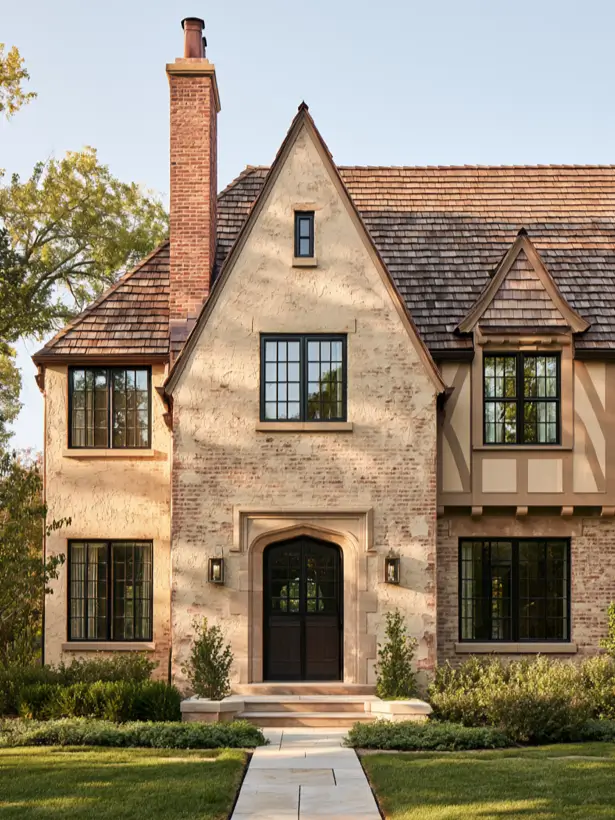
Simplified Half-Timbering
Here’s the fact that should shape every decision on this list: half-timbering on American Tudor Revival homes is almost entirely decorative. In medieval England the timbers were structural. In 1920s America they’re boards applied over conventional framing. Editing them is not structural vandalism.
9. Reduce, don’t erase
Fewer, wider timbers in a cleaner geometry reads modern. Removing them entirely usually reads as a house that lost an argument.
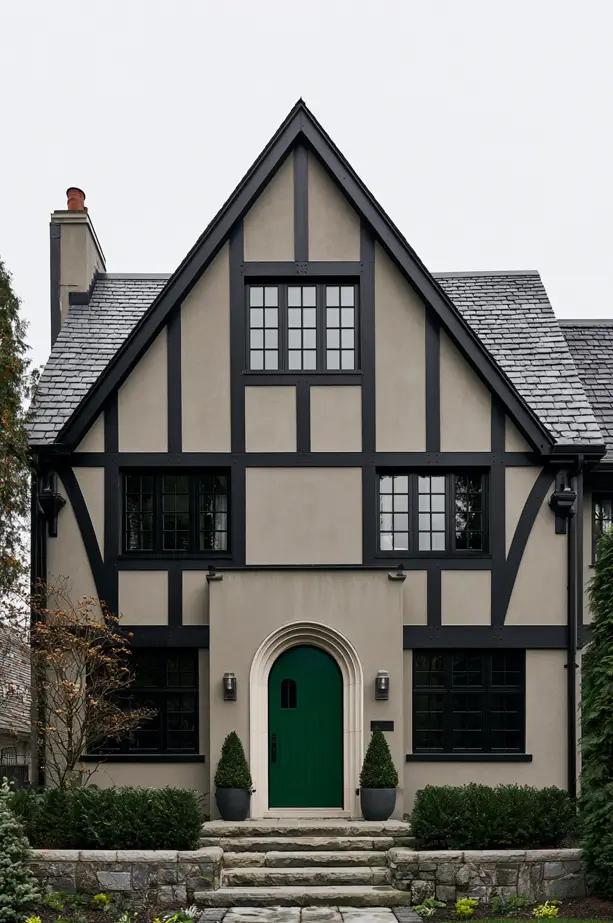
10. Change the colour instead of the layout
Charcoal grey gives half-timbering a modern edge — lighter than dark brown but still holding strong contrast against pale stucco. The cheapest meaningful modernization on this list.
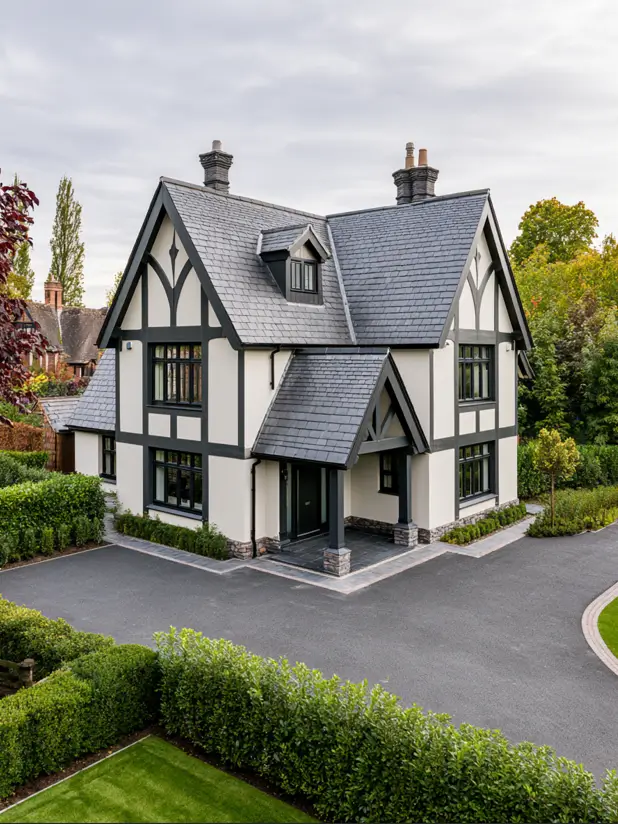
11. Confine timbering to the front gable
Let the rest of the facade go smooth. The gable carries the style; the walls carry the calm.
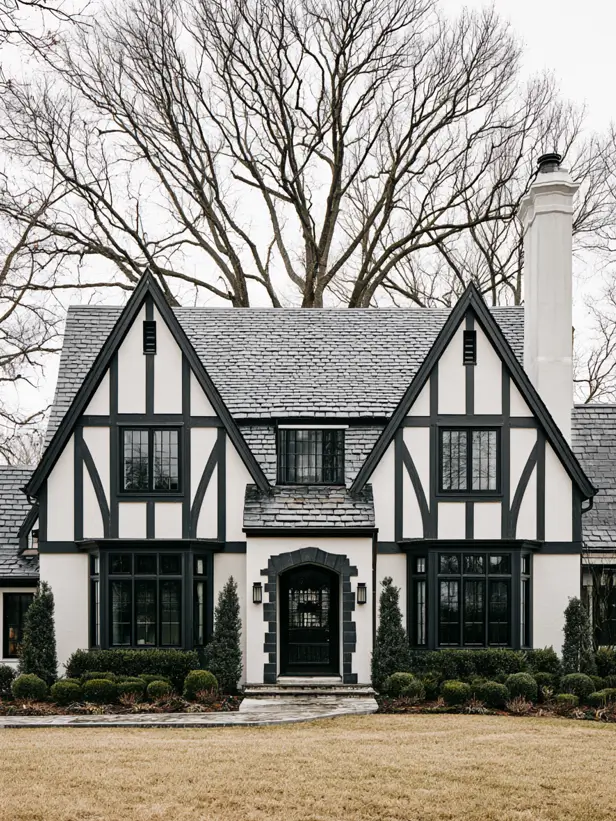
12. Use fibre cement or decay-resistant wood for replacements
Real-wood beam replacement runs $2,000–$5,000+ each; minor repair and restaining is $500–$1,500 per section. Contractors working on original Tudors consistently recommend cedar or cypress if you’re staying in timber, and back-priming every face — especially the end grain, where water gets in.
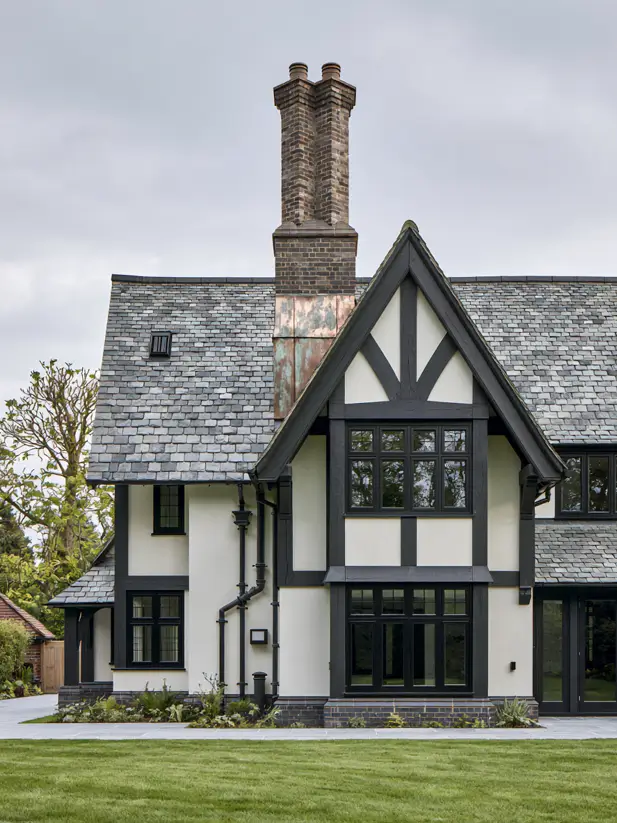
The detail that decides whether your timbers last
This is the part no design article tells you, and it’s the difference between a facade that survives thirty years and one that rots in eight.
Timber must sit over the stucco, not flush within it. If stucco meets the boards edge-to-edge, you’ve built a water trap — moisture gets behind the timber and can’t drain. Boards mounted proud of the stucco let water run past. Contractors who’ve opened up failed Tudor facades describe the same picture repeatedly: thin stucco over fibreboard with timber set into it, completely rotten for the bottom ten inches or so.
Where building departments get involved, the required assembly typically looks like this: shear panel as backing; two layers of 30lb roofing felt where the timber will sit, extending at least 6″ beyond it; Z-flashing over the top edge of each timber, tucked under the stucco paper by roughly 3″ and lapped about ½” onto its face; a metal stucco stop at the bottom so stucco never touches wood; and back-primed, painted boards, all six faces, ends included.
Moisture, not sun, is what kills Tudor timber. If a contractor proposes setting new timbers flush into fresh stucco, get a second quote.
Modern Tudor Colour Palettes
The rule nobody tells you: a Tudor needs 4–6 coordinated colours, not the usual 2. You have stucco, timbers, brick, roof, window trim, and door — six surfaces, each needing a decision. Treating a Tudor like a modern two-colour house is exactly why so many repaints look wrong.
13. The historic base
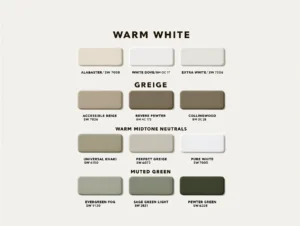
Warm cream stucco with deep chocolate timbers: Benjamin Moore Navajo White OC-95 or Sherwin-Williams Antique White SW 6119 for the body, SW Black Bean or BM Tudor Brown for the timbers.
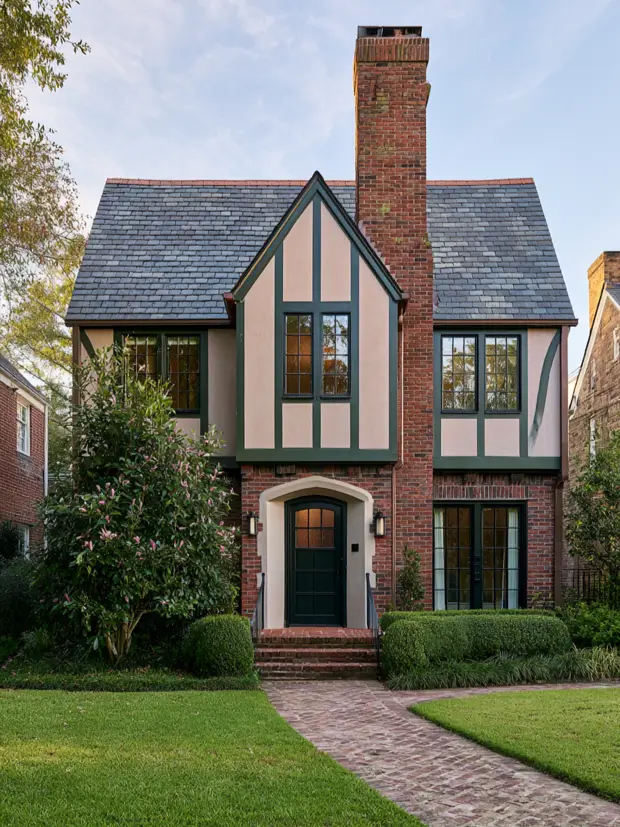
14. Blue-grey or charcoal timbers instead of brown
Designers used Sherwin-Williams Cyberspace on the timbers, vents, soffits, fascia, garage door, and gable beams of a Denver Tudor — an earthy blue that stays neutral in bright sun. Where an HOA rejected it as too dark, Sherwin-Williams Web Gray (a dark blue-grey, LRV 13) was used instead, and the designer preferred the result. Dark colours are the most common HOA rejection, so it’s worth knowing the softer alternative.
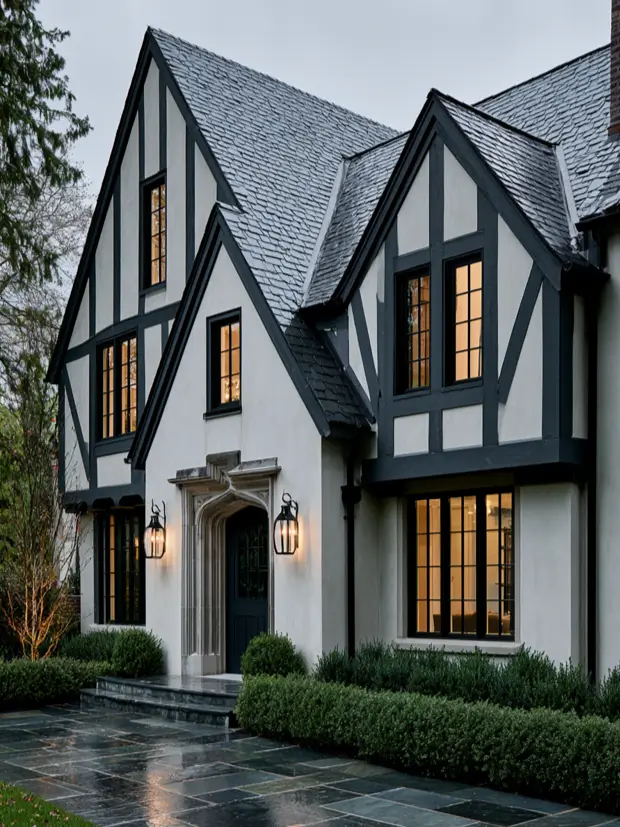
15. Low-contrast modern
Sherwin-Williams Fawn Brindleon trim, soffits, fascia, and gable beams against a darker beige stucco. A second version: Benjamin Moore Swiss Coffee body with Benjamin Moore Pale Oak trim — two colours only slightly apart, which makes the house feel timeless rather than graphic.
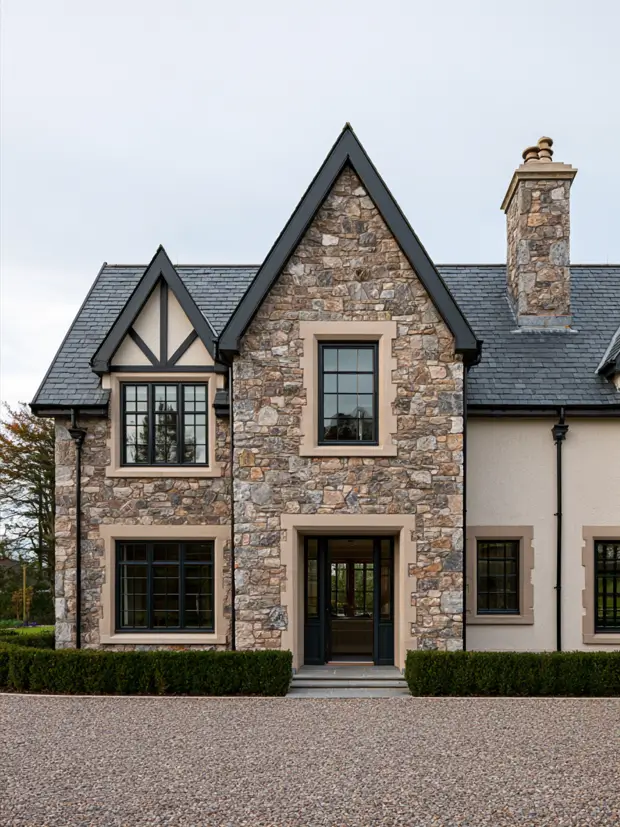
16. Calm white with near-black trim
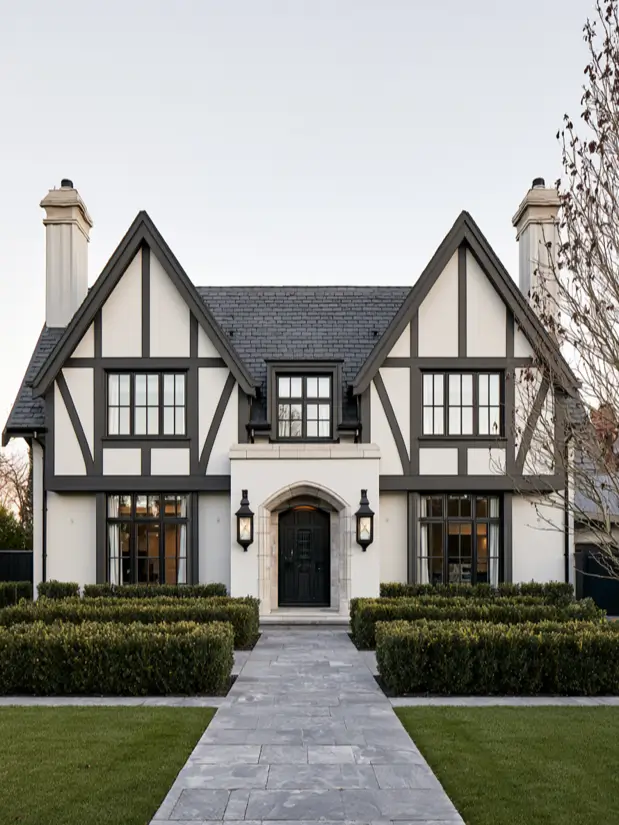
Sherwin-Williams Origami White on limewashed brick or stucco, trimmed in Benjamin Moore Dragon’s Breath. The cleanest high-contrast modern Tudor scheme going.
17. Warm neutrals over cool grey
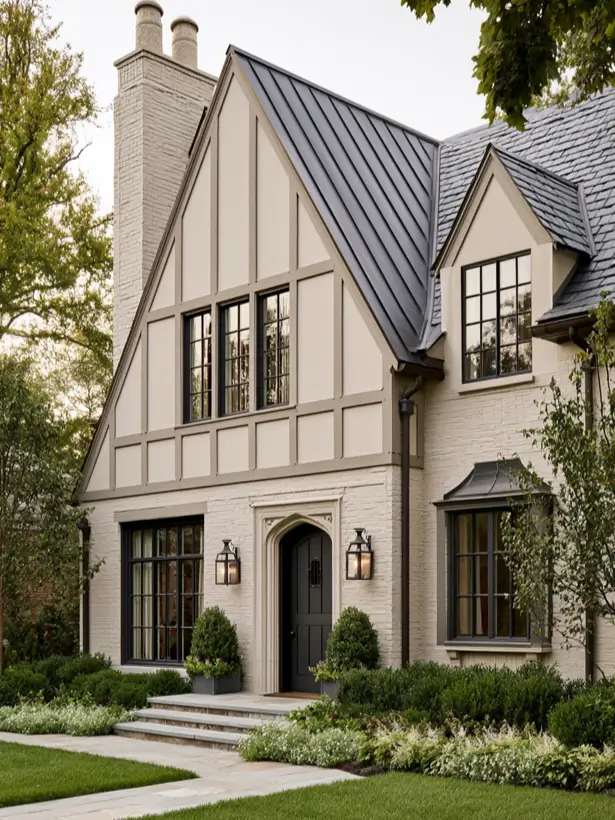
Cool grey is the single most dating colour on a Tudor — the style is rooted in warmth, and grey makes it read sterile. Replace bright white stucco with warm greige or soft taupe. Sherwin-Williams Universal Khaki SW 6150, the 2026 Colour of the Year, sits perfectly here.
18. Near-black, not black
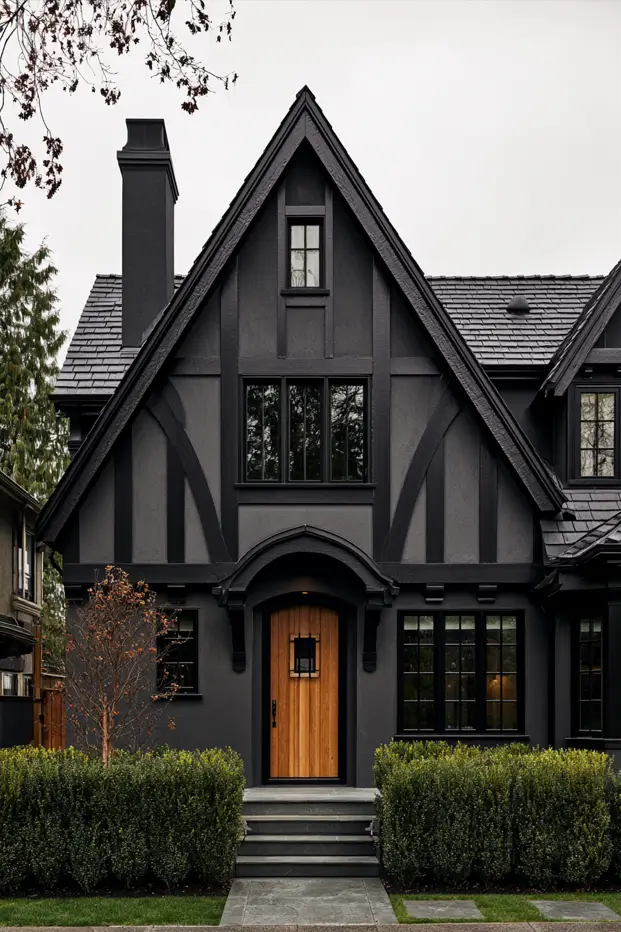
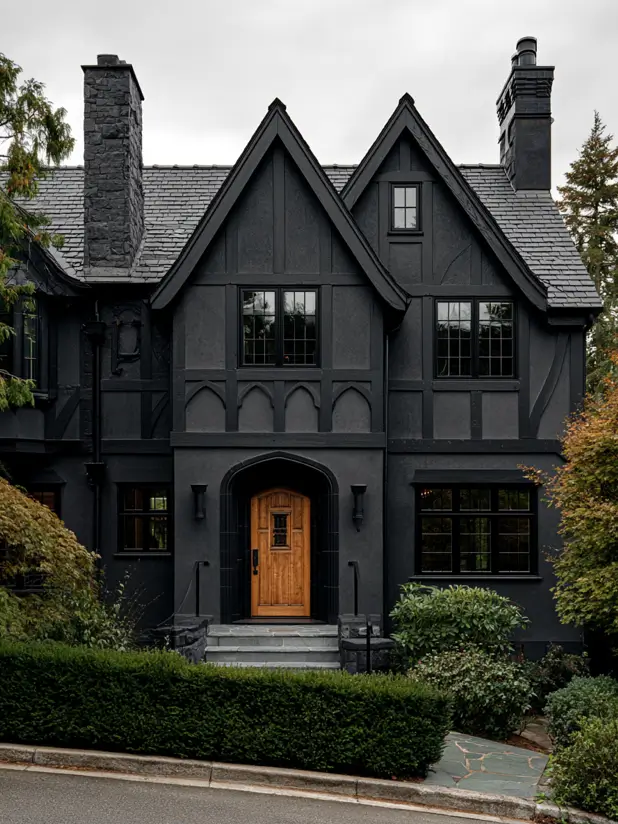
Sherwin-Williams Iron Ore SW 7069 for siding or timbers — darker than grey, softer than true black. SW Tricorn Black where you want full commitment.
The colour mistakes that ruin a Tudor
Painting timbers the same colour as the stucco (it erases the pattern that defines the style — reduce the contrast, don’t delete it). Cool grey anywhere. Painting the brick chimney (almost always wrong — leave it exposed). A white front door (you’ve wasted the strongest accent on the facade). Testing the door colour without the stone (your entry surround can’t be painted, and deep red reads regal against warm sandstone but awkward against cool grey). And forgetting the vergeboards — the trim along the gable edge belongs to the timber framework, so paint it with the timbers, not the body.
The Entry and Front Door
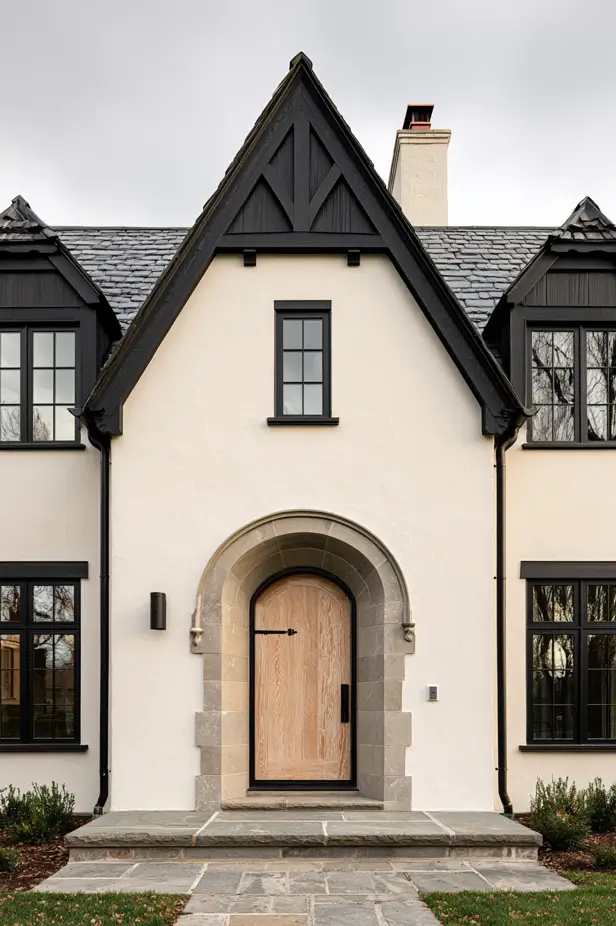
19. Keep the arch, simplify the door
A clean white oak plank door with matte black hardware in the original arched opening is the single best-value modern Tudor move.
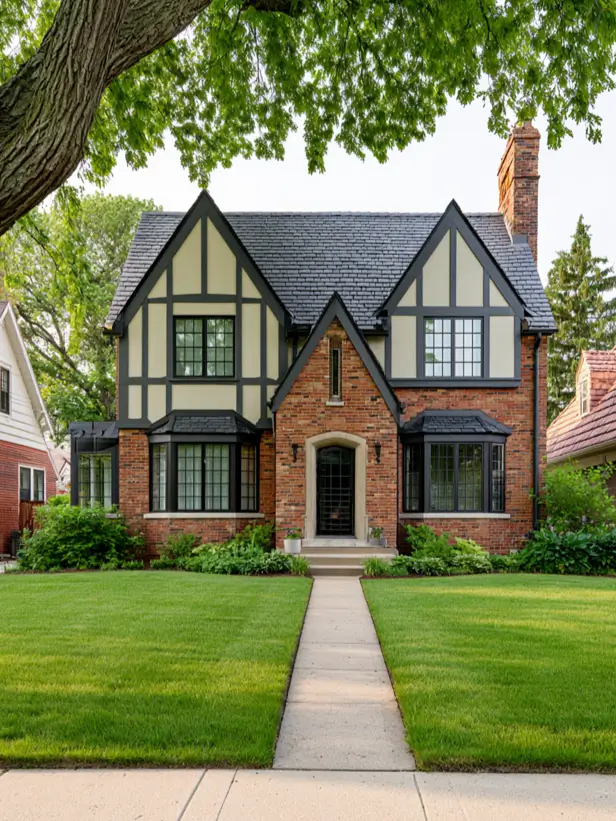
20. Modern Tudor at twilight in snow
The most instructive Tudor transformations leave the roofline, chimney, and arch untouched and change only four things — brick lightened, windows blacked, timbers recoloured, landscaping cleared. Here the bones do the talking, and the warm glow does the rest.
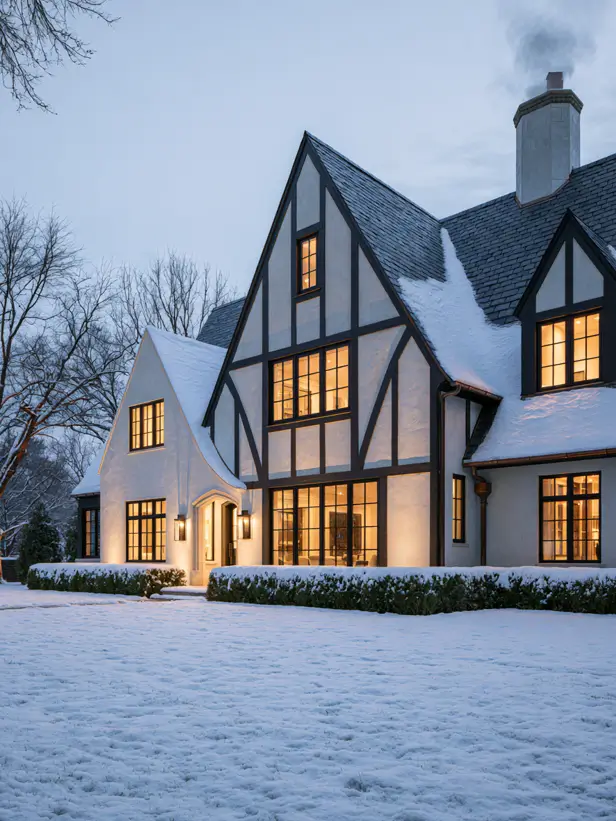
21. Add glass and light at the entry
Sidelights and a curved transom bring daylight into the darkest part of a Tudor plan without touching the facade’s proportions. Pair strap hinges, an iron ring pull, and two proper lanterns instead of one builder fixture — under $600 for a visible change, and on a Tudor entry a live gas flame does something no LED replicates.
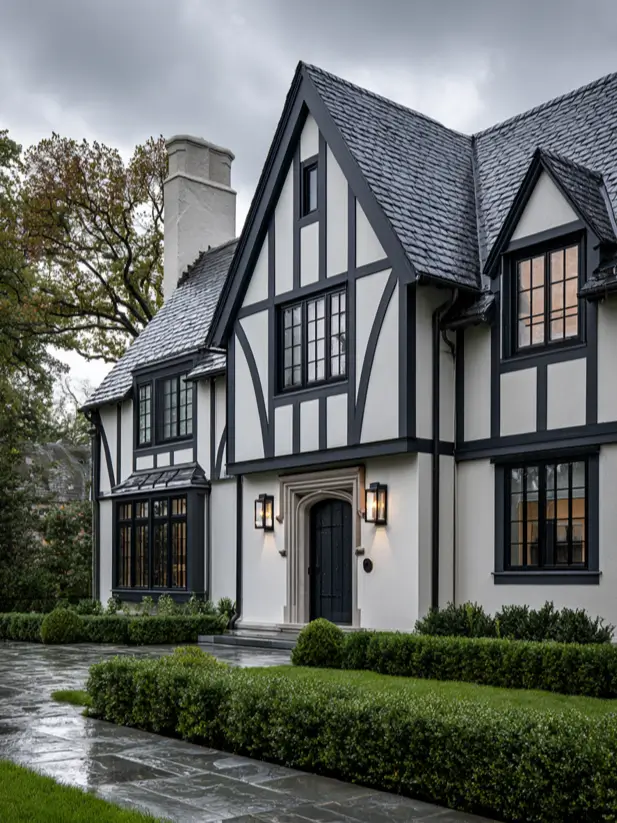
Roof, Chimney, and Materials
22. The roof is 40% of what you see
On a Tudor with a 45°+ pitch, the roof is the largest visible surface on the house. A new charcoal architectural shingle or natural slate changes the facade more than any wall colour will.
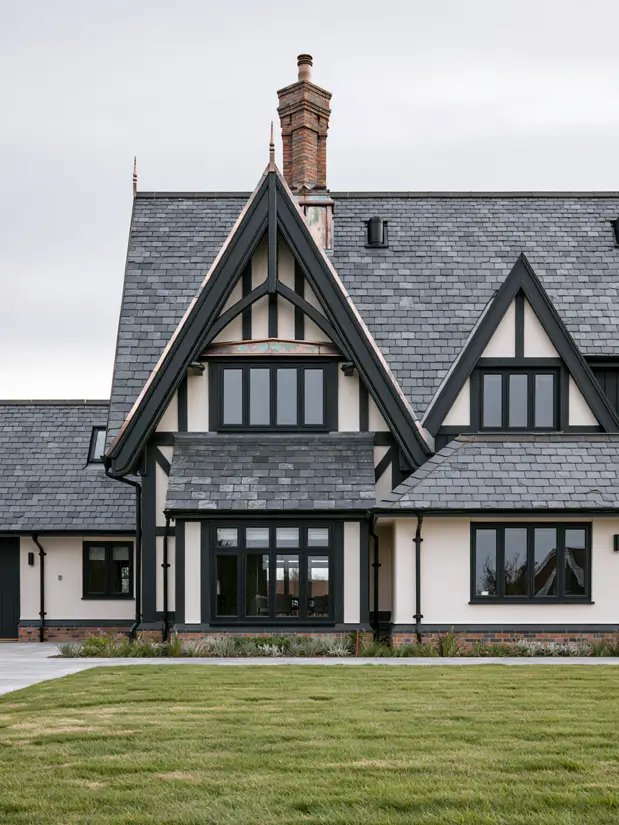
23. Slate is the historic answer
Expect $25,000–$70,000 for a 2,500 sq ft home, with a 75–150 year lifespan. Synthetic slate delivers most of the look at a fraction of the cost. Watch the valleys — complex Tudor rooflines mean more leak points, so budget for flashing when you re-roof, not after.
24. Keep the chimney, clean it up
Repoint rather than paint. Repointing runs roughly $15–$30 per square foot. Add or restore chimney pots — they’re the detail people photograph.
25. Copper ages into the palette
Copper gutters, a copper bay roof, or copper flashing patina into exactly the green-brown range Tudor palettes already live in. Expensive, but it gets better rather than worse.
Mixed Materials — the Rule of Three
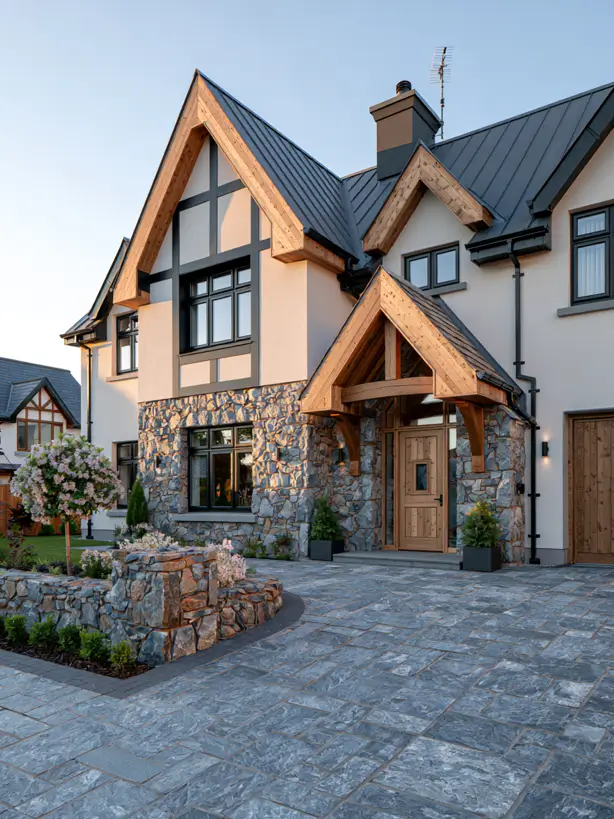
26. Three materials, no more
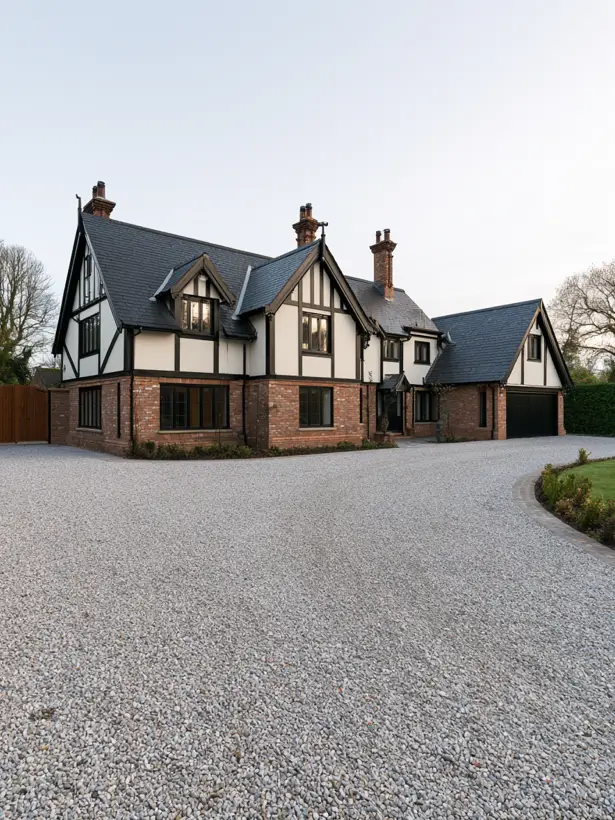
Brick, stucco, timber. Or stone, render, wood. A fourth material is where Tudor renovations go to die.
27. Add warm wood
Cedar soffits, an oak door, timber garage or entry accents. Every trending 2026 facade has warm wood somewhere.
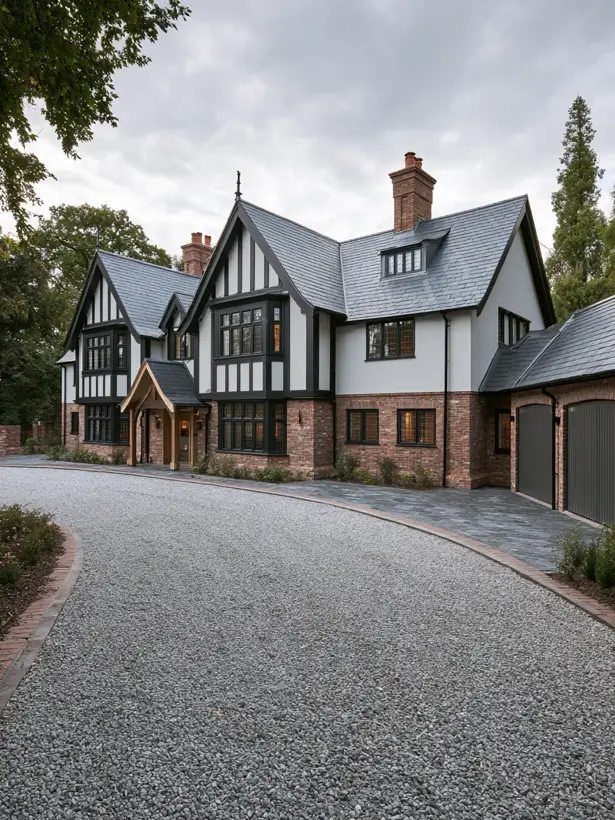
28. Use light stone to brighten
Pale limestone quoins, entry surround, and base course lift a heavy brick facade without painting anything. Choose stone that weathers at a similar rate to your existing brick, or accept the fresh-against-aged contrast deliberately.
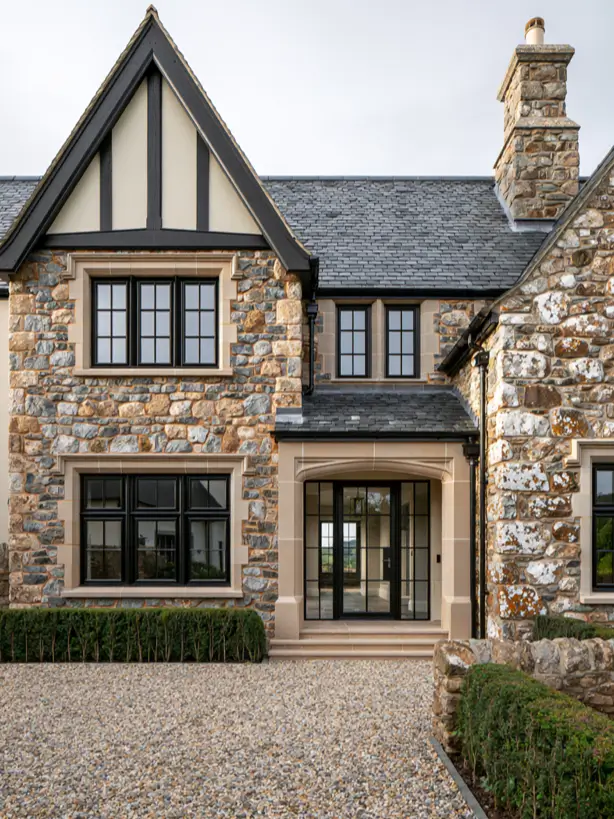
Garage, Landscaping, and Lighting
29. Treat the garage as part of the facade
On a Tudor, the garage is often a third of what you see from the street — so treat it as architecture. Black arched carriage-style doors set into a brick surround with stone lintels read as part of the facade, not a hole in the wall.
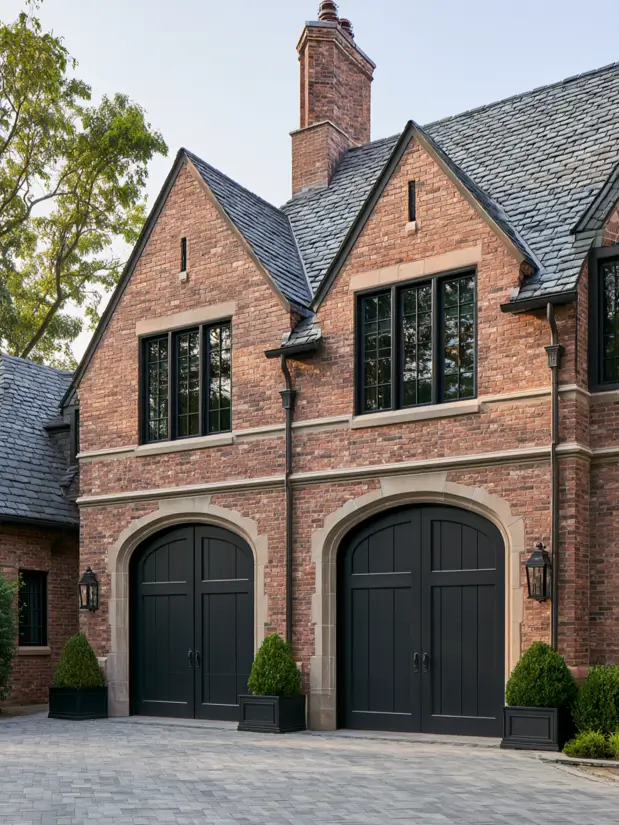
30. Evergreen structure, not flowers
Tudors want clipped, year-round green. Boxwood and yew for delicacy, holly for weight. Keep foundation planting low, though — the decorative brickwork at the base of a Tudor is a feature, and overgrown yews hide the thing you paid to restore.
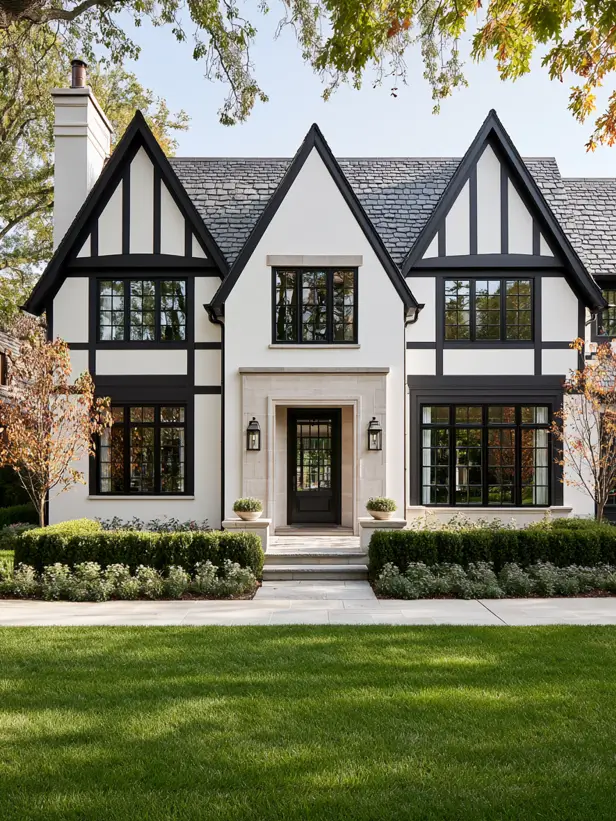
31. Columnar evergreens at the entry
Two upright evergreens flanking the arched door echo the pointed gable above it. Oldest trick in Tudor landscaping and it still works.
The Small Tudor Cottage
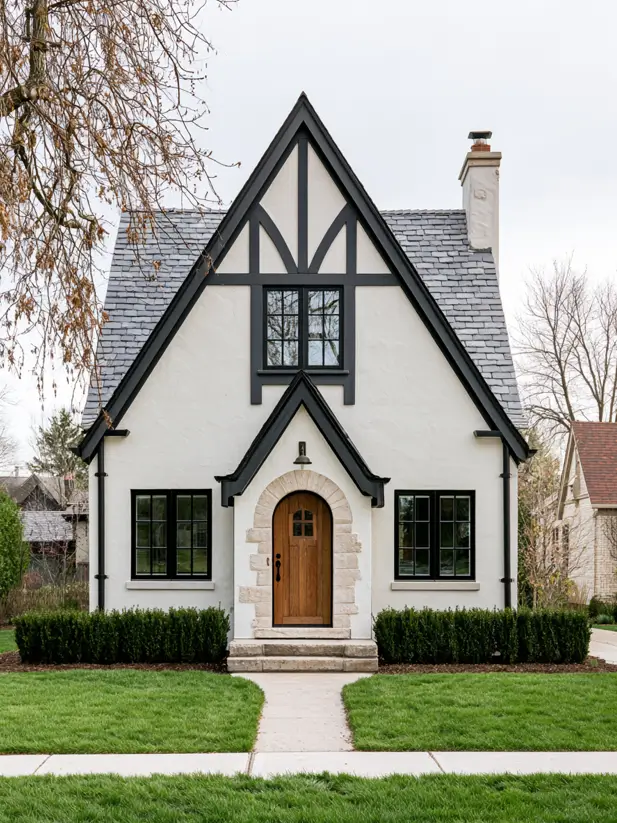
Not every Tudor is a Stockbroker mansion, and the compact ones are having their own moment. Tudor cottages under 1,800 square feet deliver an extraordinary amount of architectural drama for their footprint — the steep gable and arched entry give them real street presence even on a narrow urban lot, and they’ve become a genuinely distinctive option for first-time buyers and downsizers who don’t want a generic new build.
32. Prioritise the entry on a small Tudor
On a compact facade the entry is the house, so door, lighting, and the arch surround come first, before you spend anything on windows or roof. And restraint matters more: one bold accent colour on a small facade is a statement, two is chaos.
What a Modern Tudor Exterior Costs
Real ranges, drawn from national remodeling and contractor sources. Everything below varies substantially by market — treat these as planning figures and get local quotes before committing.
| Project | Typical range |
|---|---|
| Repaint timbers and trim only | $3,000 – $8,000 |
| Limewash brick (professional) | $3 – $7 per sq ft |
| Minor half-timber repair, per section | $500 – $1,500 |
| Timber replacement for rot, per beam | $2,000 – $5,000+ |
| Stucco patching, per area | $300 – $800 |
| Full wall re-stucco | $5,000 – $15,000 |
| Brick repointing | $15 – $30 per sq ft |
| Window replacement, per unit installed | $800 – $1,500 |
| Slate or clay tile roof, ~2,500 sq ft | $25,000 – $70,000 |
| Full exterior modernization | $40,000 – $150,000+ |
Two budgeting rules for a house this old. Carry a 15–20% contingency — older homes hide lead paint, asbestos, termite damage, and structural surprises, and Tudors hide them more than most. And sequence by visibility per dollar: paint and landscaping first, windows and door second, roof and masonry last.
Will It Pay Off? The Honest Answer
Most articles imply Tudor automatically equals premium. The truth is more useful.
Style matters less than fit. Resale value is driven less by architectural style itself than by how well that style fits its local market. A Tudor in the Midwest may command a premium; the same house in Phoenix may sell at a discount. Before you budget a $60,000 renovation, look at what comparable Tudors in your market actually sold for.
Where Tudors do outperform, here’s why. Real estate professionals consistently report that well-preserved Tudor Revivals beat comparable properties, and the drivers are specific: the style photographs exceptionally well, which matters enormously in an online-first market; the cultural association carries genuine cachet; and many were built when craftsmanship was standard, so solid masonry, original leaded glass, and hand-crafted detail come as standard in a way newer houses can’t match.
The failure mode is over-renovation. A Tudor Revival loses much of its value when renovated into something generic — because the buyers paying premium prices are seeking authenticity, and authenticity requires knowledgeable stewardship. Every dollar you spend erasing character is a dollar spent lowering your ceiling.
And most buyers are shopping existing stock. Per the National Association of Realtors’ 2025 generational trends report, 71% of buyers purchased a previously owned home. Your competition isn’t new construction — it’s the other character homes in your neighbourhood, and most of them haven’t been modernized well.
The Mistakes That Cost the Most
Over-modernizing — remove the timbering, square the arch, flatten the palette, and you’re left with a house that isn’t Tudor and isn’t modern either, just anonymous. Setting timbers flush into stucco — the technical failure that costs the most later. Ignoring the historic commission — windows, roofing, and half-timbering are precisely what commissions care about. Painting brick you’ll want back — limewash and mortar wash give you most of the effect with far more forgiveness. And treating it like a two-colour house — six surfaces, six decisions.
FAQ
What makes a Tudor “modern”? Preserving the steep gables, arched entry, and asymmetrical massing while updating what dates it: black-framed windows instead of small dark leaded casements, a lightened palette of warm whites and greiges instead of orange-brown stucco, reduced and recoloured half-timbering, and layered exterior lighting.
Should I remove the half-timbering? Usually no — reduce it instead. American Tudor half-timbering is decorative rather than structural, so editing it is legitimate, but removing it entirely often leaves a facade with no identity. Fewer, wider timbers in charcoal reads modern while keeping the style clearly readable.
What’s the best paint colour for Tudor timbers? Charcoal grey is the most reliable modern choice — it holds contrast against pale stucco without the heaviness of dark brown. SW Cyberspace and SW Web Gray have both been used successfully on real projects, and SW Iron Ore sits between grey and black. Never paint timbers the same colour as the stucco.
Can I paint the brick on my Tudor? Yes, but consider limewash or a mortar wash first. Both lighten the brick while keeping texture and colour variation, and both are far more forgiving than full paint, which is permanent and needs redoing every seven to ten years. Never paint the brick chimney.
How much does it cost to modernize a Tudor exterior? A paint-and-landscaping refresh runs $5,000–$15,000. A meaningful modernization with new windows, limewashed brick, and updated timbering runs $40,000–$80,000. A full exterior renovation including roof and masonry can exceed $150,000. Carry a 15–20% contingency on any Tudor project.
Why does Tudor half-timbering rot? Moisture, not sun. When timbers are set flush into stucco, water gets trapped behind them and cannot drain. Boards mounted over the stucco, with flashing above and a stucco stop below, let water run past. Back-priming all six faces including the end grain is essential.
Where to Start
If you’re doing this in stages, this order gives you the most visible change per dollar: clear the landscaping (free to cheap, and it reveals architecture you already own); paint the window frames black (highest impact per dollar on the list); repaint the timbers charcoal (modernizes the facade without touching a material); new front door and lighting (under $3,000 for a transformed entry); limewash the brick (the big one — do it after you know the rest of the palette); then windows and roof (the expensive structural work, last).
The houses that get this right are the ones that changed the fewest things. Tudor already has more character than almost any style in American housing. The job isn’t to add character — it’s to stop hiding it.
Sources: National Association of Realtors 2025 Home Buyer & Seller Generational Trends Report; Remodeling Cost vs. Value Report; Sherwin-Williams and Benjamin Moore colour specifications from published designer projects; Classic Architecture Today on Tudor Revival valuation; contractor and building-department practice documented on Fine Homebuilding and Old House Web. Cost figures are national planning ranges and vary by market.