Skip to content


Quick answer (what makes a ranch “modern”?): A modern ranch house exterior keeps the style’s defining feature — a long, low, horizontal profile — and updates its skin rather than its bones. The signature moves are a darker or higher-contrast paint palette, black-framed windows and larger glass, a mix of materials (stone, wood, metal, siding), a simplified entry, and clean, architectural landscaping. You modernize the surface; you protect the low roofline.
The one rule that keeps this from going wrong: modernize the skin, protect the bones
If you remember nothing else, remember this. A ranch’s power is its horizontality — the way it hugs the ground and stretches across the lot. Almost every modern-ranch update that fails does so because someone fought that horizontal line instead of celebrating it: a too-tall gable slapped onto a low house, three competing rooflines, a facade that can’t decide what it is.
So here’s the framework I’d use, call it the 70/30 rule for ranches: put about 70% of your effort into the “skin” — color, materials, windows, entry, lighting, landscaping — and only about 30% into structural changes, if any. The skin is where nearly all the visual payoff lives, at a fraction of the cost and risk. The bones stay low and long.
Five things you never change (this is the ranch’s DNA):
- The low-pitched roofline and wide, deep eaves.
- The single-story, ground-hugging horizontal proportion.
- The horizontal rhythm of the windows (ribbon and picture windows).
- On a true mid-century ranch, its original character materials — cedar lap siding, a stone knee wall, breeze block.
- The connection between the house and its yard.
Five things you should change:
- A dated, flat, single-tone paint job → add contrast or go moody.
- Small, divided-light windows in thin frames → black frames, bigger glass.
- A blank, low-coverage entry → one clean point of emphasis.
- A single flat material across the whole facade → mix two or three.
- Overgrown foundation shrubs and dated lighting.
One restraint rule to hold you back from overdoing it, borrowed from designers who do this for a living: keep the facade to no more than three materials or “features” total — one body, one contrast, one accent. Modern ranch reads as calm and deliberate. Clutter is the enemy.
First, figure out which ranch you actually own
Generic advice is why most ranch makeovers look wrong. The right move depends entirely on which ranch is sitting on your lot:
- A true mid-century modern ranch (roughly 1945–1965): flat or low-slope roof, deep eaves, exposed rafter tails, big glass, often cedar and stone. Here, “modern” means restoration plus restraint — clean it up, don’t costume it.
- A 1960s–70s brick or builder rancher: solid brick, a hip roof, smaller windows. This one takes color and material contrast beautifully and is the most forgiving to modernize.
- A 1980s–90s ranch (sometimes with faux-traditional trim): the one most likely to have dated details fighting each other. Modernizing here often means subtracting ornament, not adding it.
Match the ideas below to your house, not to a photo of someone else’s.
1. Mix your materials
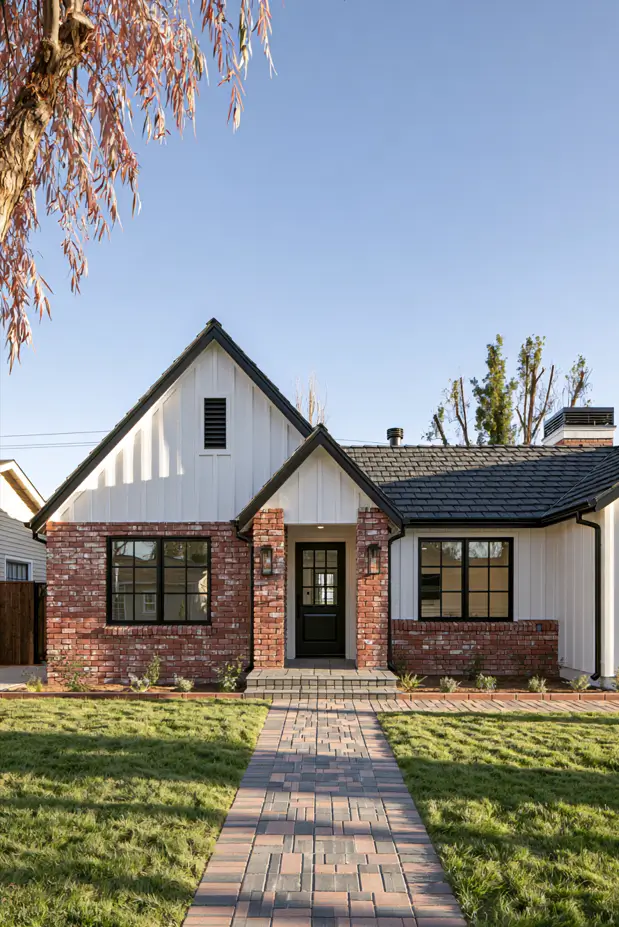
Red brick on the lower walls with crisp white board-and-batten above is the modern-ranch material formula in action — two materials, not five. The black-framed windows and herringbone paver path tie it together, proving you don’t need a full rebuild to make a single-story ranch look custom.
2. Warm it up with real wood
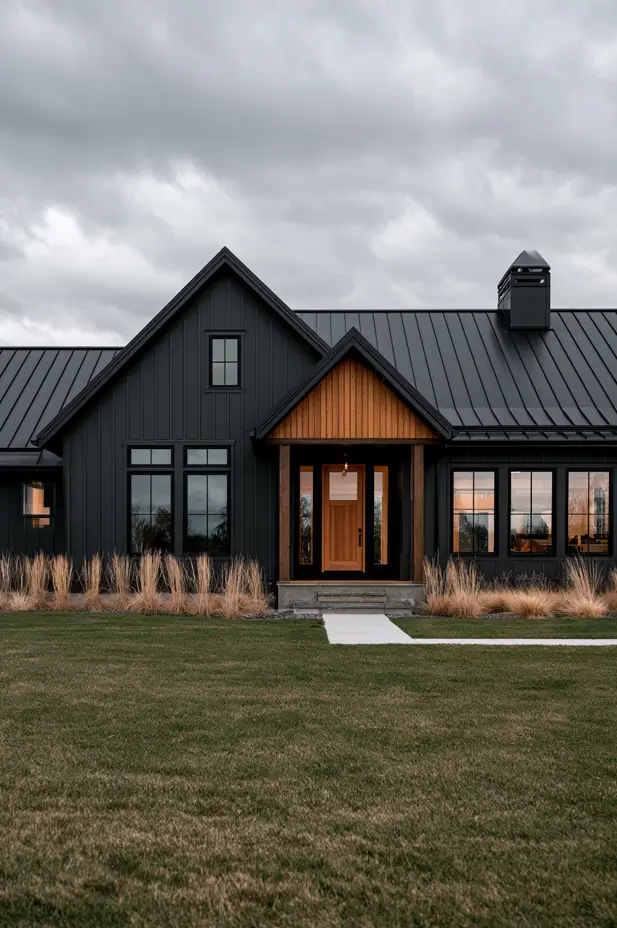
Go all-black on a ranch and it can read severe — until you add warm wood. Here a single cedar-clad entry gable and matching door do all the work, softening the black board-and-batten and standing-seam roof into something inviting. It’s the one detail most DIY dark makeovers skip, and the reason theirs look harsh.
3. Give the entry one clean point of emphasis
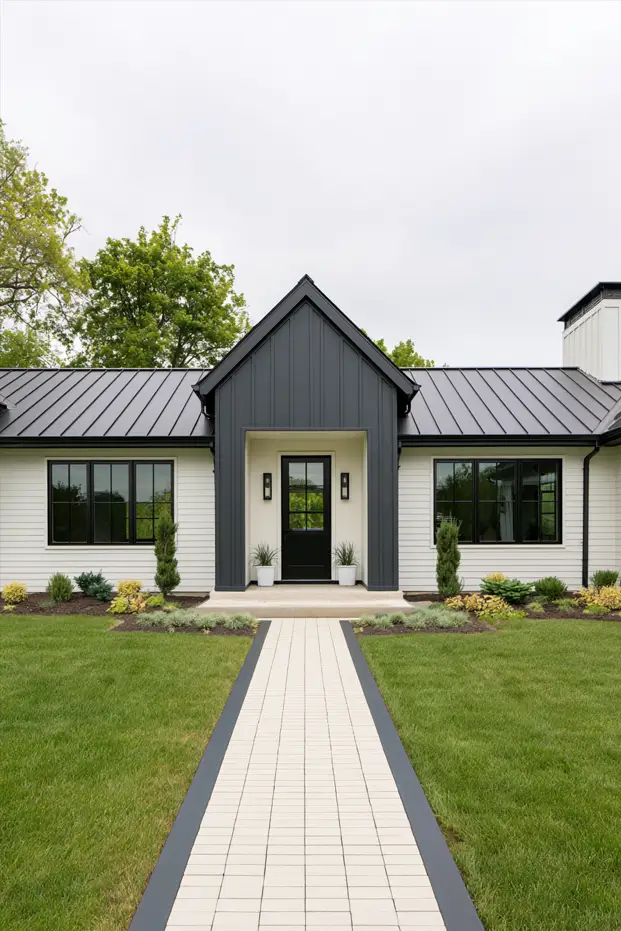
A ranch entry is usually its weakest point — low and easy to miss. Here a single dark board-and-batten portico rises to a peak against the white body, pulling every eye straight to the door. That’s the “one vertical lift” rule: concentrate one bold gesture at the entry instead of scattering small ones across the facade.
4. Swap the Garage Door — Your Highest-Return Update
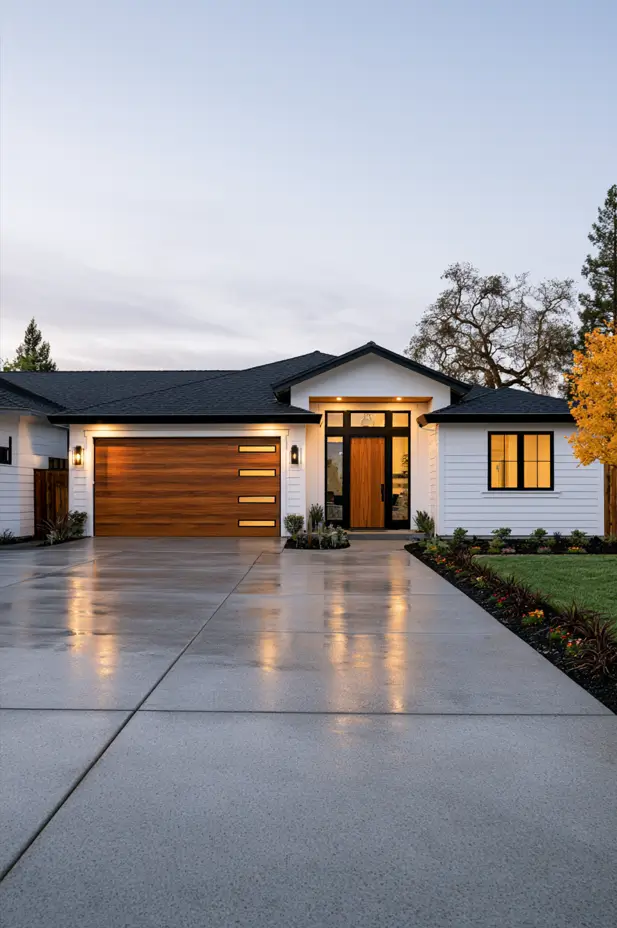
On a ranch, the garage door is often the biggest thing facing the street — which is exactly why replacing a dated one delivers the most payoff per dollar. This warm walnut-toned door with slim glass bars modernizes the whole white facade in a single day, and the resale math backs it up: garage door replacement returns about 268% at resale (2025 Cost vs. Value Report)
5. One Gable, Done Right
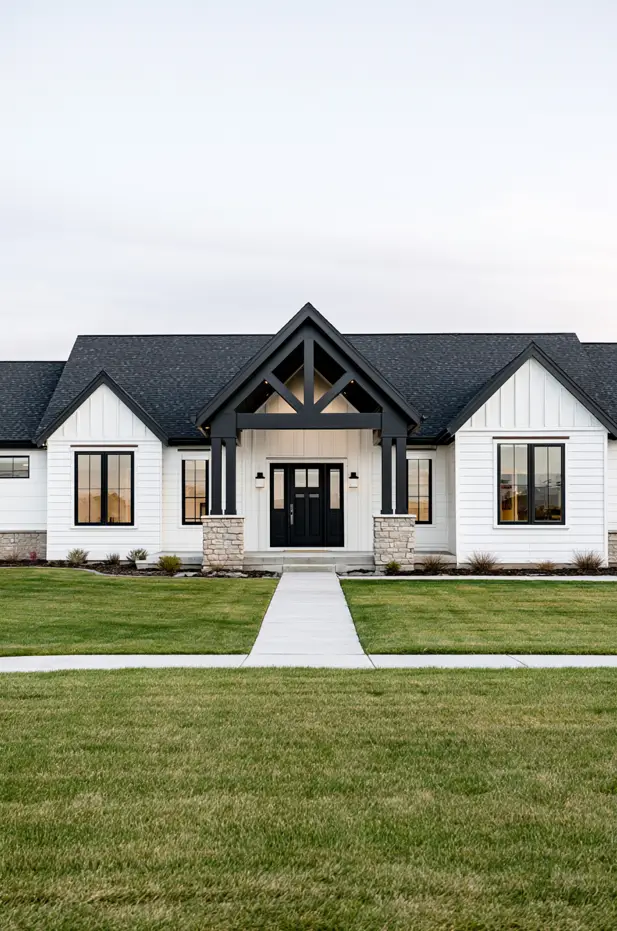
Should you add a gable to a ranch? Sometimes — if it’s one restrained gesture. Here a single timber-truss entry gable adds just enough height and drama while the roofline stays low and horizontal on either side. That’s the balance: one deliberate peak for emphasis, never a row of competing rooflines that turn a graceful ranch into an awkward box.
6. Let Your Landscaping Echo That Low Roofline
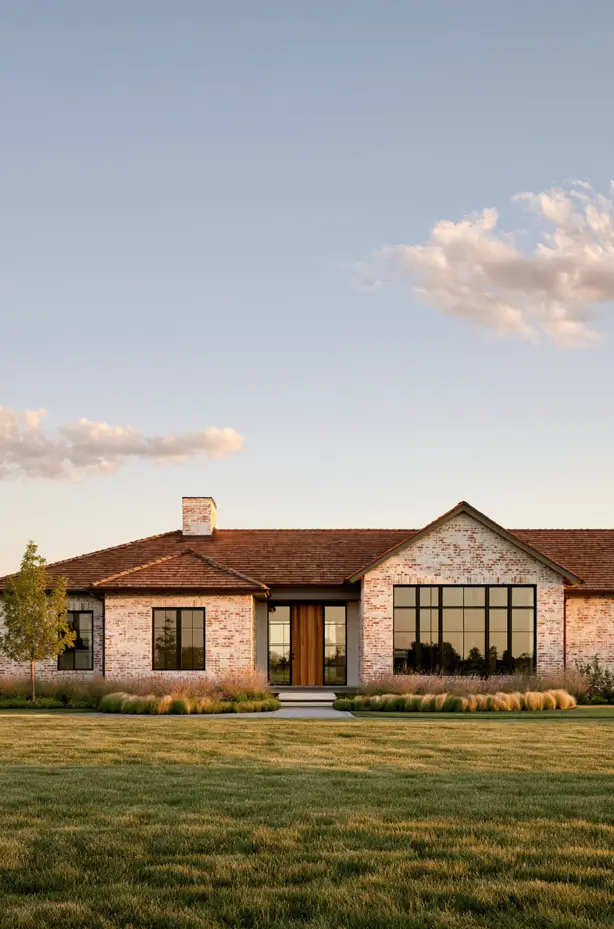
A ranch is long and low, so the planting should be too. Here a continuous band of ornamental grasses runs the full length of the foundation — sitting below the windows, never swallowing them — and mirrors the horizontal roofline instead of fighting it. Pair that with soft limewashed brick and one slim vertical tree for balance, and the whole composition feels calm and intentional.
7. Earthy modern
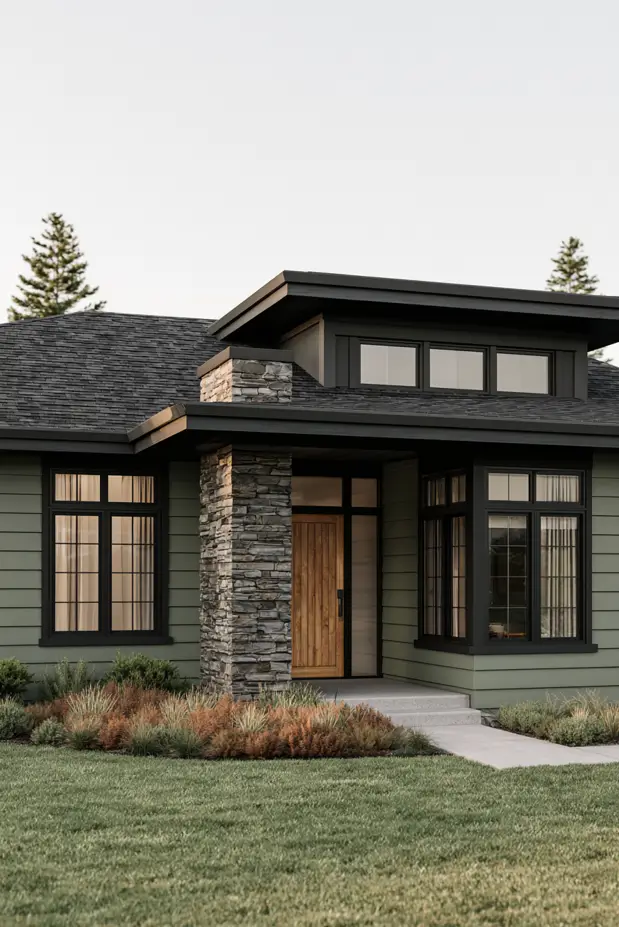
Mid-century ranches were born into warm grays, olives, and muted greens — so leaning into a soft sage body reads as both modern and authentic. Here it’s grounded with a stacked-stone entry column, a warm wood door, and a horizontal clerestory window, all in the low Prairie spirit. Earthy green also flatters the landscaping, which matters when the yard is half the picture on a low house.
8. A Defined Walkway Pulls the Whole Ranch
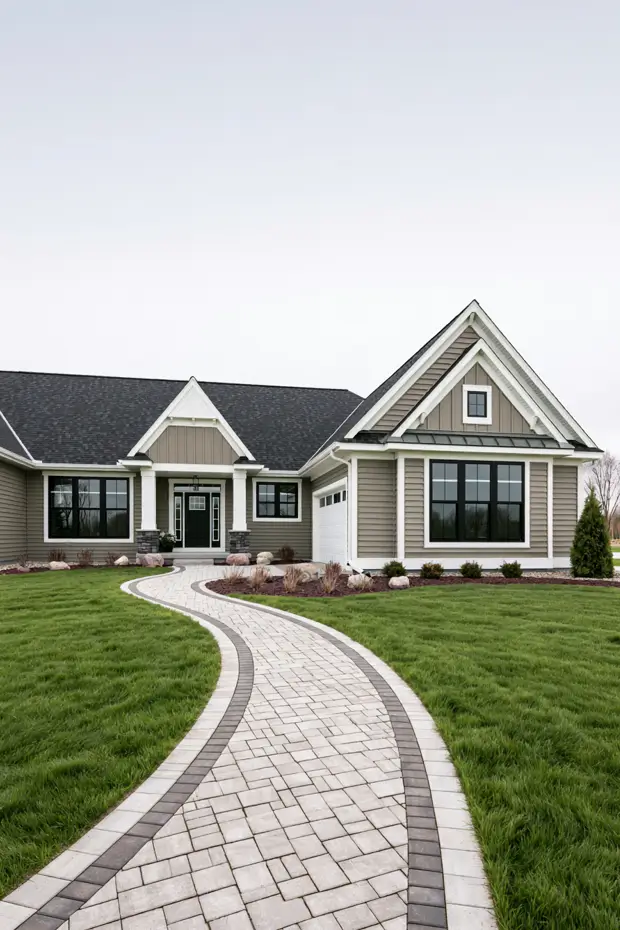
On a long, low house, the walk to the door does real work. A curved paver path with a contrasting charcoal border draws the eye from the street to the entry and softens a wide facade far better than a straight slab. Keep the curve gentle and the border crisp — it reads as designed, not just poured, and it’s one of the highest-impact landscaping dollars you can spend.
9. Ground it with stone
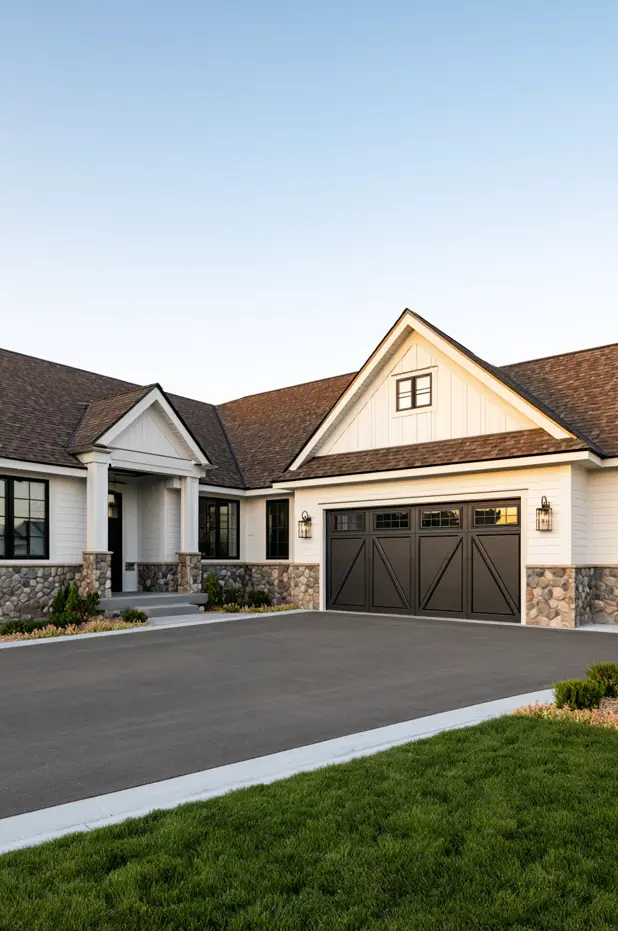
A band of river-rock stone across the lower walls gives a ranch the weight and texture that flat siding can’t — it reads as permanent and custom. Run it as a wainscot beneath the windows, as here, or as a skirt across just the front. It’s also one of the smartest resale dollars: manufactured stone veneer returns about 208% at resale (2025 Cost vs. Value Report).
10. A Black Metal Roof Drops the Visual Weight
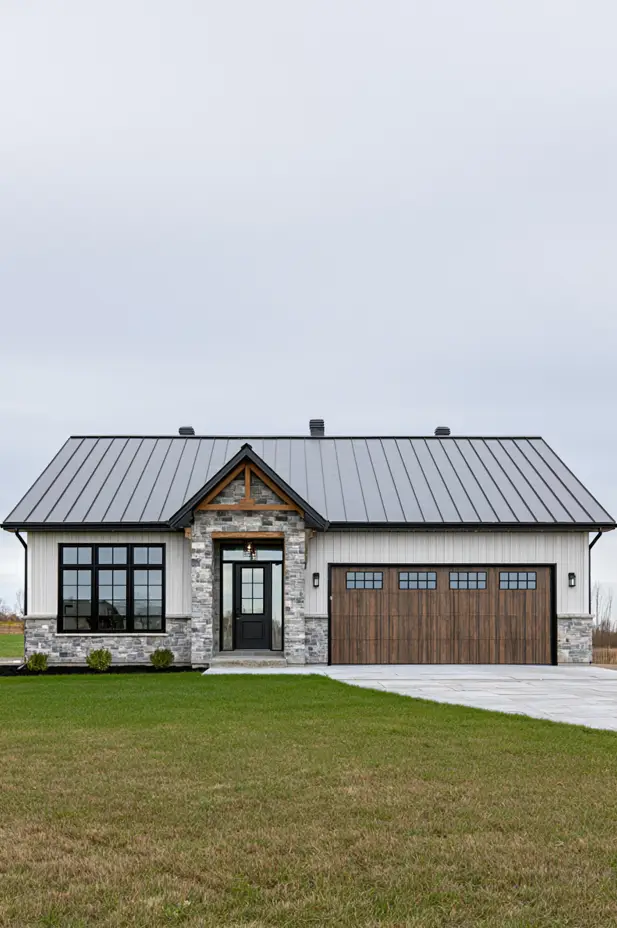
Swapping shingles for a black standing-seam metal roof is one of the highest-impact modern-ranch moves that doesn’t require touching the structure. The long vertical seams and crisp dark edge make the roofline feel even lower and more grounded — exactly the effect you want on a ranch — and metal outlasts asphalt by decades. Pair it with stone and warm wood so the black roof reads intentional, not heavy.
11. Warm neutral with a wood entry
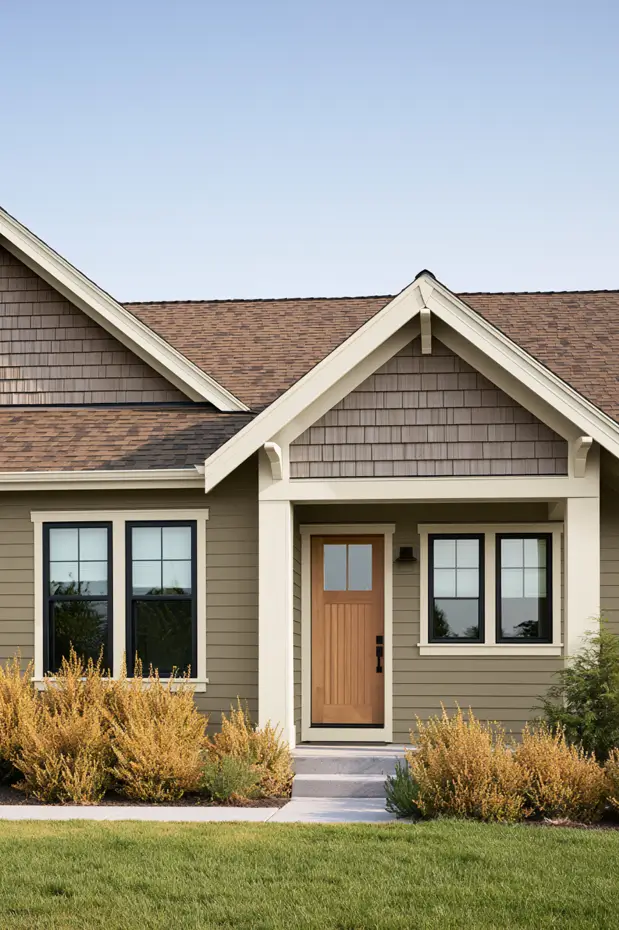
Not every modern ranch has to shout. A warm greige body paired with a single natural-wood door reads as calm, custom, and genuinely expensive — and it ages far better than any trend color. This is the palette for owners who want “updated,” not “dramatic,” and the one wood element against the neutral siding does all the work.
12. Swap to black-framed windows
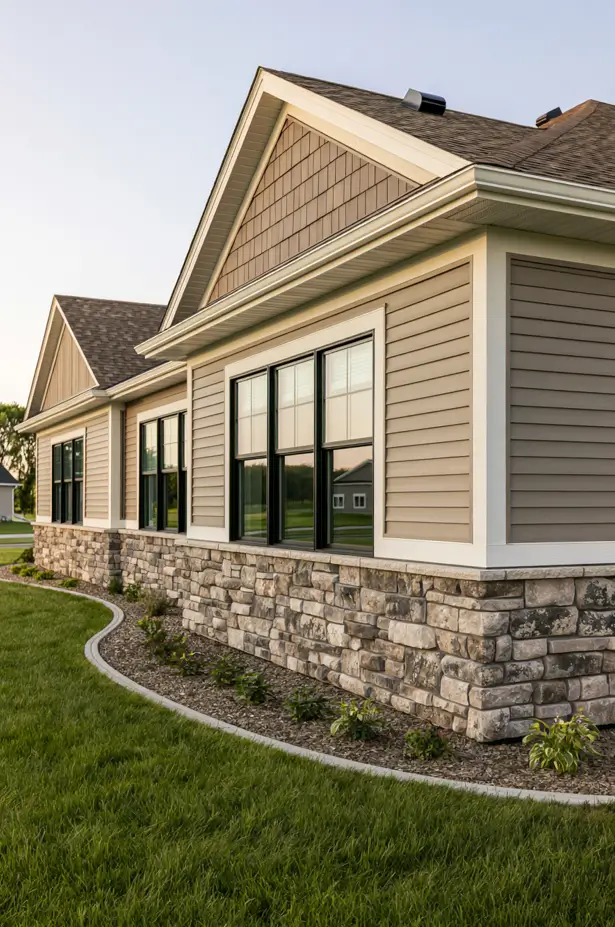
If you change one thing besides paint, make it the window frames. Black frames read instantly as “contemporary,” and on a ranch they sharpen the horizontal window rhythm that already defines the house — as this long run of black windows over a stone base shows. You don’t always need new windows either; on many homes, exterior frame paint or a wrap gets the look for a fraction of replacement cost.
13. White body, black everything
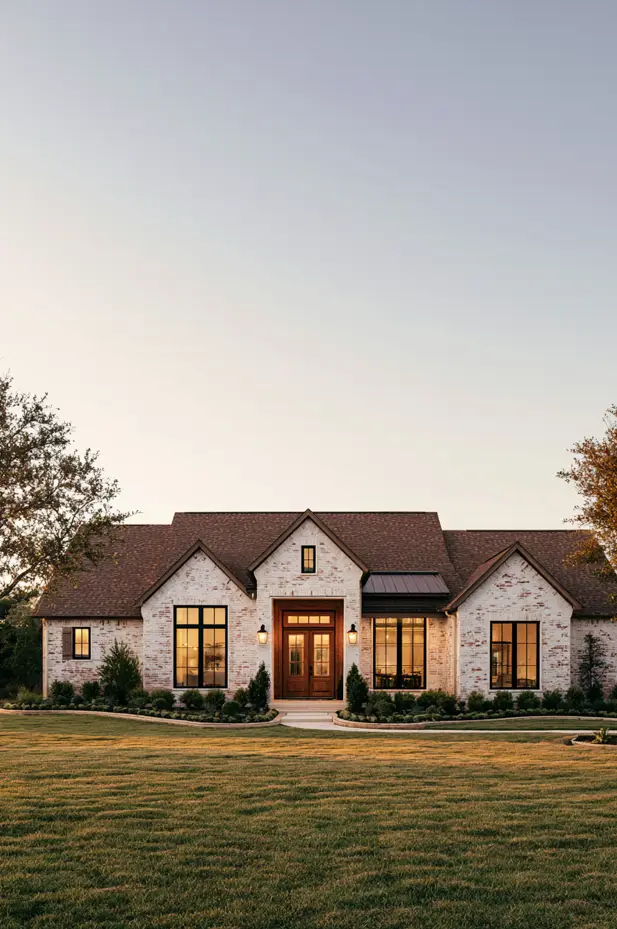
Want the modern look without the risk of a dark body? Soft whitewashed brick with black window frames and a black-metal roof accent is the highest-resale-safe modern palette — the contrast does all the modernizing, and it flatters brick, siding, and stucco alike. Keep the white warm (limewashed, not a cold builder white) so it glows against a green lawn instead of looking sterile.
14. What a Modern Ranch Really Looks Like
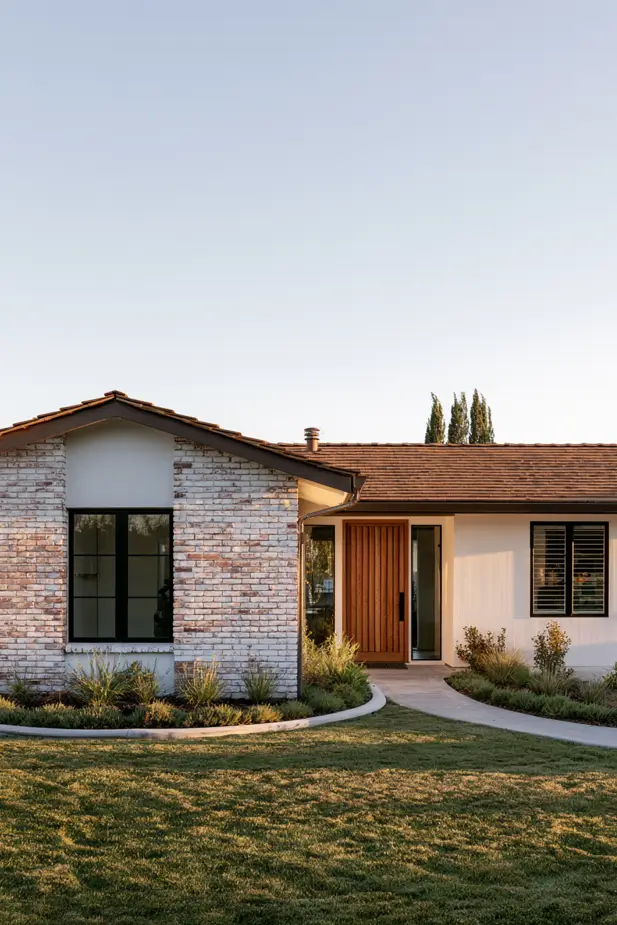
The modern ranch at its best: a long, low, single-story profile under a wide-eaved tile roof, whitewashed brick and white stucco warmed by a natural-wood door. Nothing here fights the horizontal line — it’s celebrated. That’s the whole idea behind every update in this guide.
15. Modern hardware, lighting, and numbers
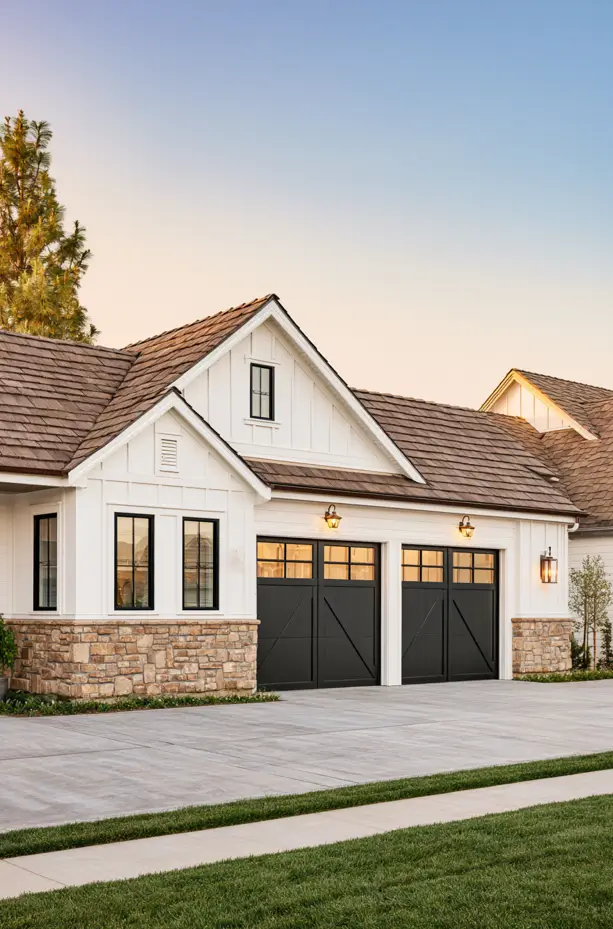
The least expensive modern-ranch upgrade is also one of the most effective: swap dated fixtures for clean lantern or matte-black sconces, add large modern house numbers, and update the door hardware. At dusk, warm-lit sconces like these make the whole facade feel intentional — and buyers read these small details as a proxy for how the entire house is maintained. A few hundred dollars, outsized impact.
16. The Two-Tone Ranch Look
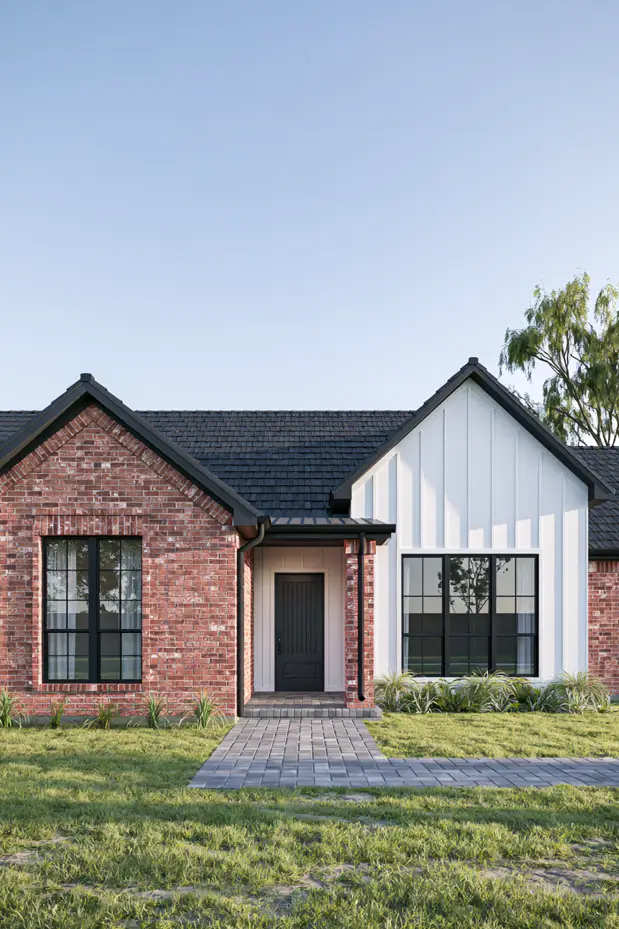
Can’t decide between brick and siding? Use both. Running red brick across one wing and crisp white board-and-batten across the other — tied together by a single black roof and black windows — gives a ranch a graphic, custom-built look without a dark all-over body. The trick is letting the black roofline and window frames unify the two halves so it reads as designed, not indecisive.
17. Blur indoor and outdoor living
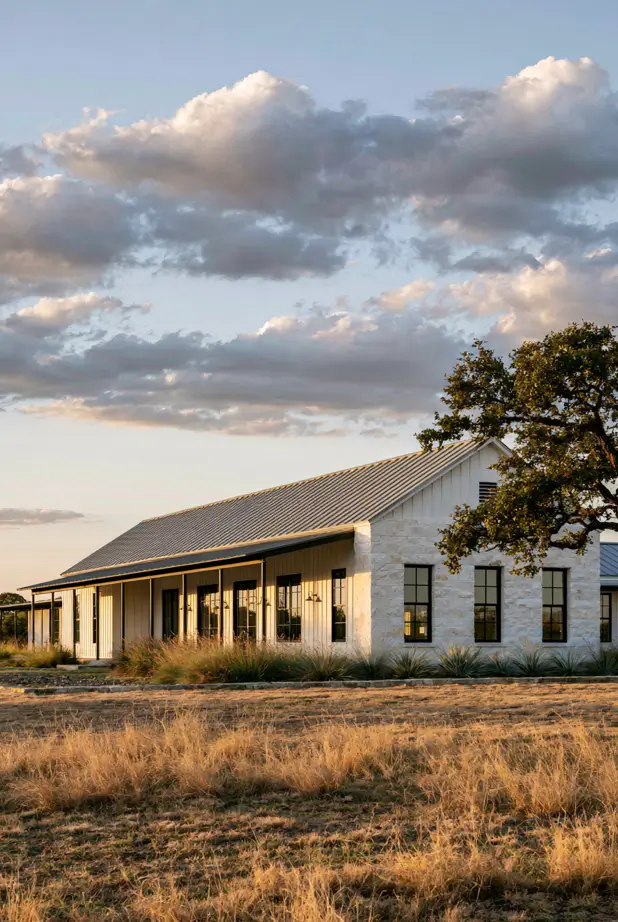
The original genius of the ranch was its bond with the yard — and a long covered porch running the length of the facade is how you honor it. Here the porch and breezeway pull the living space outward toward the field, exactly what these low, horizontal homes were built to do. It’s the update you enjoy every single day, not just from the street.
18. Go All-In on a Dark, Moody Ranch
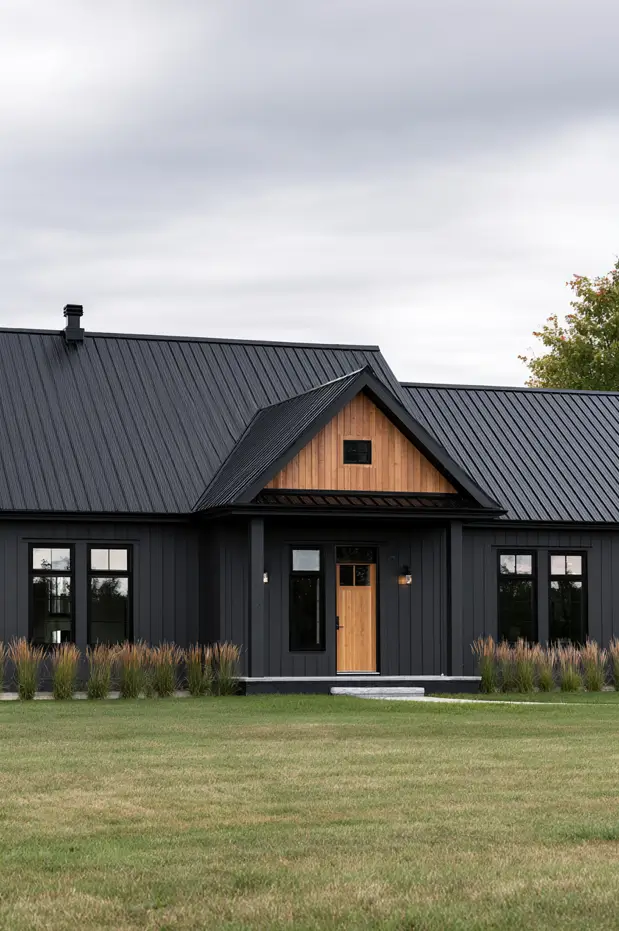
A full charcoal or near-black body is the defining modern-ranch move of the moment — and on a low, horizontal house it emphasizes that long roofline rather than hiding it. Reach for Sherwin-Williams Tricorn Black (SW 6258) or the slightly softer Benjamin Moore Wrought Iron (2124-10). One rule, no exceptions: balance all that black with a warm wood entry, or the facade reads cold instead of confident.
19. Turn the Entry Into a Sit-a-While Porch
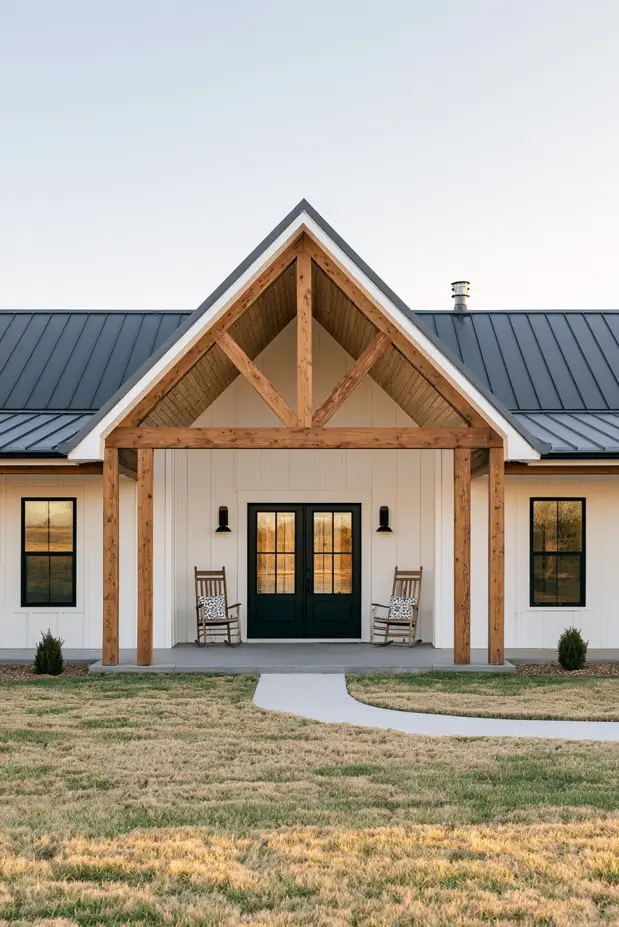
A covered porch does more than shelter the door — it creates an outdoor room. Here a cedar timber-truss porch with a pair of rocking chairs turns a flat entry into a place you actually use, adding depth and warmth to a facade that would otherwise read as one plane. Even a modest version of this is the detail that makes a ranch feel considered, not just repainted.
20. Limewash the Brick for an Instant
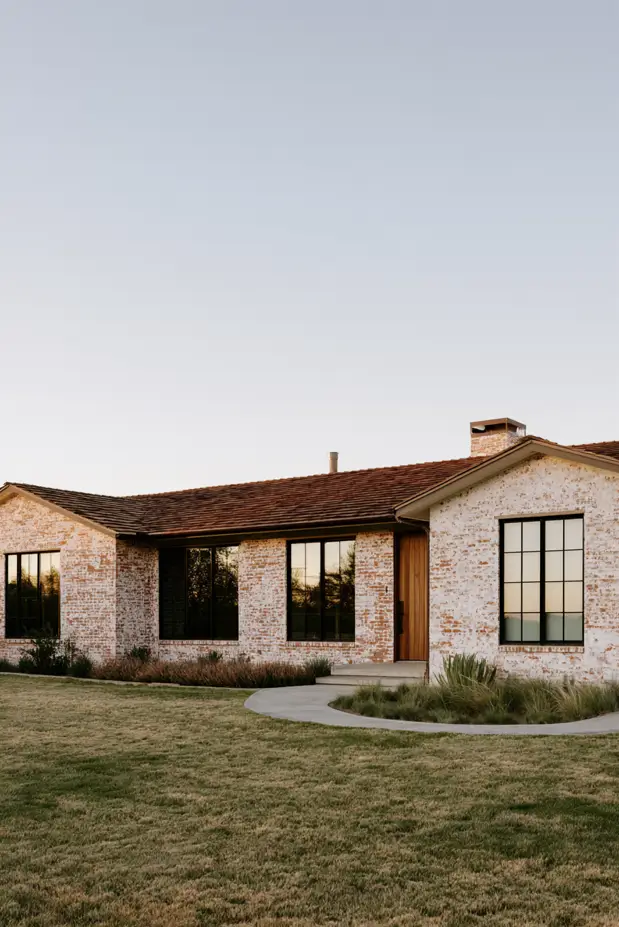
Have a dated red-brick ranch? You don’t have to paint over it or replace it. A German-schmear or limewash softens the brick to a warm, mottled off-white that reads immediately modern while keeping the texture and character underneath. Paired with black windows and a natural-wood door, it’s one of the highest-impact, lowest-cost ways to bring a brick ranch into the present — and it’s breathable, so it won’t trap moisture the way solid paint can.
The construction reality no design blog tells you
This is the section that separates real advice from a photo gallery. Before you fall in love with a roofline change, understand what’s actually under there.
Truss vs. stick framing decides everything. Most ranches from the 1960s on use prefabricated roof trusses, which fill the attic with a web of interlocking members. That means there’s usually no usable attic space to convert, and you can’t simply “add a dormer” the way you can on a stick-framed roof. Older or custom ranches may be stick-framed (individual rafters), which is far more flexible. Figure out which you have before you plan anything.
“Going up” often means raising the whole roof. Because ranch roofs are low-pitched, adding real headroom frequently means removing the existing roof and framing a steeper one — sometimes lifting the trussed roof off in one piece. It’s dramatic and expensive, and it triggers a cascade of costs most people don’t anticipate.
The chimney and masonry trap. One builder’s real-world example: he wanted to raise his ranch’s roofline for more space, but once he priced carrying the brick veneer up new gable ends and extending a three-flue chimney the required four or five feet to clear the new roof, the numbers killed the plan. He settled for a shed dormer instead. If you raise a roof, every masonry element has to grow with it.
Gable-end vs. hip roofs perform differently. A gable-end roof is the cheapest to frame but is more vulnerable to wind and snow loads because wind can catch and lift the flat triangular end. A hip roof (slopes on all four sides) is more stable and lets you run gutters around the whole perimeter. This matters for both the look and the engineering of any roof change.
Flat and low-slope roofs need real detailing. If you’re leaning into the modern flat-roof look, two non-negotiables: fit a metal coping cap along the parapet so the top edge stays sharp and sheds water cleanly, and never skip the minimum drainage slope under the roof membrane. Standing water finds every seam, and that repair bill dwarfs anything you saved cutting corners.
The honest takeaway: the skin changes (color, materials, windows, entry) are where DIY-friendly, high-return value lives. The roofline changes are where you need an architect, a structural look, and a bigger budget — often bigger than the result justifies.
What it costs
Two things here: the ROI figures are real and sourced (Zonda’s 2025 Cost vs. Value Report, the 38th annual edition, published by the JLC Group). The broader cost ranges are illustrative — they vary enormously by region, materials, and home size. Treat them as ballpark, and always get local quotes.
| Project | Typical national range* | Documented ROI (2025 Cost vs. Value) |
|---|---|---|
| New house numbers, sconces, hardware | $150–$600 | Not tracked (high perceived value) |
| Exterior paint (whole ranch) | $3,000–$10,000+ | Not tracked separately |
| Steel entry door replacement | ~$2,435 avg | 216% |
| Manufactured stone veneer (≈300 sq ft skirt) | ~$11,000 avg | 208% |
| Garage door replacement | ~$4,700 avg | 268% (highest on the report) |
| Fiber-cement siding (full re-side) | $15,000–$40,000+ | ~114% |
| Vinyl siding (full re-side) | ~$17,000+ | ~97% |
| New black-framed windows | Several hundred–$1,000+ per window | Varies |
| Landscaping refresh (front yard) | $1,000–$5,000+ | Varies (strong curb impact) |
| Roofline change / raise | $20,000–$100,000+ | Rarely recouped fully |
*Ranges are illustrative and vary widely by market — get local quotes before budgeting.
The pattern worth internalizing: according to the 2025 Cost vs. Value Report, eight of the ten highest-ROI home improvement projects in the country are exterior replacements. For a ranch, the entry door, garage door, and a stone accent are the three that reliably return more than they cost.
Will a modern update actually pay off? The honest answer
Not always, and not automatically — and anyone who tells you a style is “always premium” is selling something.
Here’s the nuanced truth. Curb appeal genuinely moves the needle: in HomeLight’s End-of-Year 2024 agent survey, nearly half of agents (48%) called curb appeal the strongest selling point in their market. And exterior replacements dominate the ROI rankings, as the table shows. So the targeted updates — door, garage door, paint, stone accent, landscaping — are among the safest money in home improvement.
But two cautions. First, fit-to-market beats style. An all-black modern ranch that’s stunning in a design-forward neighborhood can sit unsold in a street of traditional brick homes. Renovate toward what your specific buyers want, not toward what’s trending on Pinterest. Second, over-renovation destroys value. Pouring $80,000 into raising a roofline on a modest ranch in a modest neighborhood almost never comes back at resale. The ranch’s whole appeal is affordable, single-level, unpretentious living — price and character your updates accordingly.
If you’re staying put, do what you love. If you’re updating to sell, stay in the high-ROI skin changes and match the neighborhood.
The modern-ranch mistakes that cost the most
- Fighting the horizontal. Adding tall gables, multiple rooflines, or a second story that turns a graceful low house into an awkward box. The horizontal is the style.
- Mixing incompatible styles. Putting mid-century details (clerestory glass, geometric screens) on the same facade as farmhouse details (board-and-batten, barn brackets). They fight, and neither wins.
- Too many materials. Four or five materials on one facade reads as busy and cheap. Cap it at three.
- A cold black house. Going dark without any warm wood to balance it. The result looks severe, not sophisticated.
- Shrubs that swallow the windows. Overgrown foundation planting is the most common — and most fixable — thing killing ranch curb appeal.
- Skipping the drainage details on a flat roof. The one place where saving money guarantees you spend more later.
Frequently asked questions
What makes a ranch house “modern”? A modern ranch keeps the low, horizontal, single-story profile but updates the surface: a darker or higher-contrast paint palette, black-framed windows, larger glass, a mix of materials like stone, wood, and metal, a simplified entry, and clean architectural landscaping. The bones stay; the skin changes.
What are the best modern colors for a ranch exterior? Three palettes dominate: a dark charcoal or near-black body (Sherwin-Williams Tricorn Black SW 6258 or Benjamin Moore Wrought Iron 2124-10), a warm white with black trim (Alabaster SW 7008), or a warm greige (Benjamin Moore Revere Pewter). Always balance dark bodies with warm wood accents so the facade doesn’t read cold.
Should I add a gable or second story to my ranch? Usually no. The low horizontal roofline is the ranch’s defining feature, and adding height often makes it look awkward, not upgraded. If your ranch is a plain builder box with little character, a single restrained portico at the entry can help — but avoid multiple competing gables, which is the most common mistake.
What’s the highest-ROI exterior update for a ranch? According to the 2025 Cost vs. Value Report, garage door replacement returns about 268% of its cost, a steel entry door about 216%, and manufactured stone veneer about 208%. On a ranch, where the garage door is often the largest street-facing element, replacing a dated one delivers the most visible payoff per dollar.
Can I modernize a ranch on a small budget? Yes. The cheapest high-impact moves are exterior paint, black-framed window paint or wraps, new matte-black sconces and oversized house numbers, updated door hardware, and ripping out overgrown foundation shrubs. Together these run a few thousand dollars and transform how the house reads from the street.
How do I know if my ranch is a true mid-century modern one? Look at the roof and the glass. A genuine mid-century ranch usually has a flat or very low-slope roof, deep eaves, exposed rafter tails, and large windows, often with cedar siding and stone accents. If it has those, lean toward restoration and restraint rather than adding new architectural features.
Where to start: the cheapest-highest-impact order
- Clean up the landscaping. Rip out overgrown shrubs, edge the beds, add mulch. Often free-to-cheap, and instantly clarifying.
- Swap the small details. Sconces, house numbers, door hardware — a few hundred dollars.
- Paint the front door a bold color or refinish it in natural wood.
- Paint or wrap the window frames black. The fastest “modern” signal for the money.
- Repaint the body in one of the three modern palettes.
- Replace the garage door — the highest ROI on the list.
- Add a stone or wood material accent for depth.
- Only then, if the house calls for it and the budget allows, consider structural moves (portico, glazing, roofline) with an architect.
Modernize the skin first. Protect the bones. That’s the whole game.