Skip to content


Looking for sage green house exterior ideas that actually work in 2026? Sage is the rare colour that reads as both a neutral and a statement, which is why it’s leading the 2026 exterior paint colour trends — and why so many come out muddy. The looks below aren’t just pretty pictures: each shows one decision you can borrow, drawn from homes I’ve worked on across warm, humid climates.
The gap between the facades that sing and the ones that sulk almost always comes down to three things — the undertone nobody tested, the trim it got paired with, and the roof that never entered the conversation. Start with the shade, because if that’s wrong, nothing downstream saves it.
How to choose the right sage green
Four decisions separate a sage that looks intentional from one that turns muddy. Sort them before you buy a gallon.
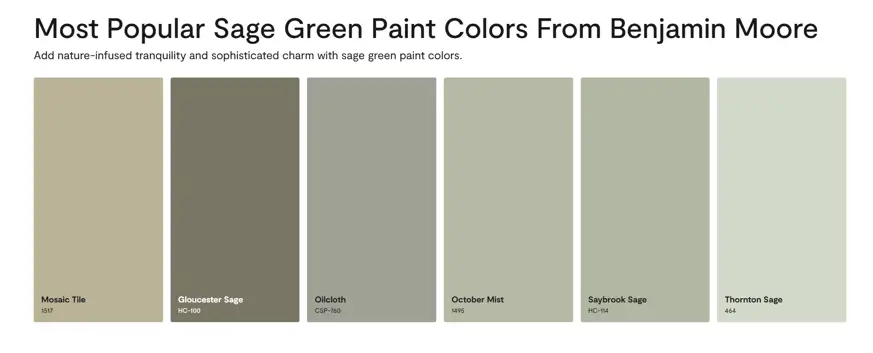
Undertone. Greyer sages (Saybrook Sage, Acacia Haze) read modern and calm; olive-leaning ones (Cushing Green, Rosemary) feel older and richer. Choose the character that suits your house first.
LRV. Light Reflectance Value runs from 0 to 100. For exterior sage, stay roughly between 12 and 47. Below about 15 reads near-black from the kerb and fades faster on a hot south or west wall, so keep the deep greens for doors and accents and give the body a safer mid-tone like Evergreen Fog (~30) or Saybrook Sage (~45).
Light. The same green shifts all day. North walls pull it grey and cool; bright south walls lift the green and yellow. Judge it on the wall that matters, morning and evening.
Fixed elements. Your roof, brick, and stone aren’t changing, and their undertones can fight the paint — a warm brown-black roof clashes with a cool grey-sage, and red brick wants a paler sage. Choose the green against what you can’t repaint.
Above all, don’t trust a chip or a screen. Paint a 60cm board, prop it on the actual wall, and check it at 8am and 6pm before you commit.
Every sage green in this guide, at a glance
Every sage named below, with its light reflectance value, undertone, and where it works hardest. Codes are correct as of 2026 — but the wall is the real test, so treat this as a shortlist to sample, not a shortcut past it.
| Paint colour | Brand & code | LRV | Undertone | Best on |
|---|---|---|---|---|
| October Mist | Benjamin Moore 1495 | ~47 | soft grey-yellow sage | stucco, cottages, light mid-sage bodies |
| Saybrook Sage | Benjamin Moore HC-114 | ~45 | warm grey-green | clapboard, farmhouse gables, all-round mid-sage |
| Acacia Haze | Sherwin-Williams SW 9132 | ~32 | muted warm grey-green | modern, ranch, mono-pitch builds |
| Evergreen Fog | Sherwin-Williams SW 9130 | ~30 | green-grey, faint blue | black-trim modern farmhouse, versatile body |
| Cushing Green | Benjamin Moore HC-125 | ~18 | grey-sage, warm-cool | craftsman shingles, stone & copper, under charcoal roofs |
| Rosemary | Sherwin-Williams SW 6187 | ~14 | warm grey-olive | deep olive bodies, doors, red-door craftsman |
| Guacamole | Benjamin Moore 2144-10 | ~13 | yellow-brown olive | deep, dramatic bodies on large modern facades |
| Pewter Green | Sherwin-Williams SW 6208 | ~12 | cool grey-olive | board-and-batten, deep bodies, doors |
For calming warm red brick, reach for a paler grey-sage. In the US that’s Acacia Haze or October Mist knocked back; the go-to international equivalents are Farrow & Ball French Gray (UK) and Dulux Chalk USA (Australia).
1. Test sage against your own light
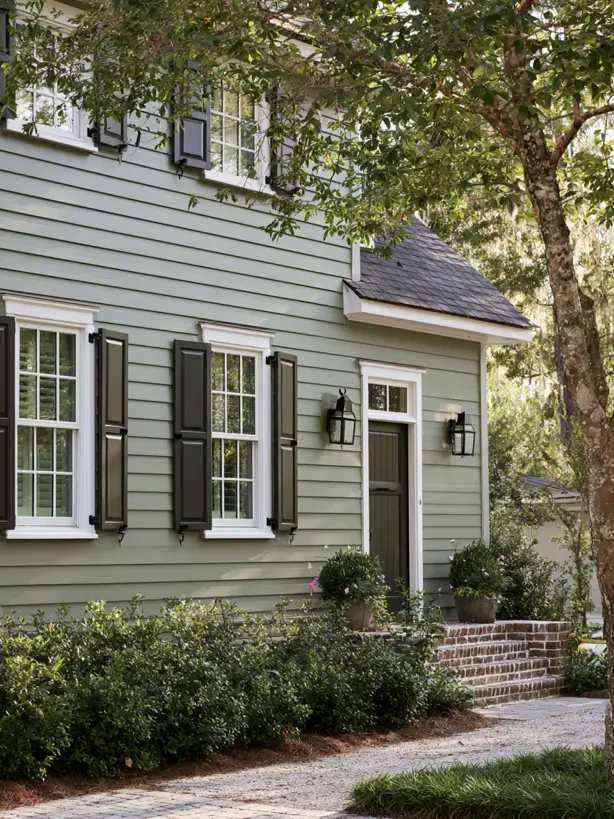
Look at how the sage changes across this one wall — cooler and greyer under the tree, a touch greener where light slips through. It’s the same paint doing two things, which is exactly why a swatch under shop lighting misleads you. This body reads closest to Benjamin Moore Saybrook Sage (HC-114), a muted mid-sage — but don’t trust that off a screen. Paint a 60cm board and read it on your own wall at 8am and 6pm before you commit.
2. Go vertical to stretch the facade
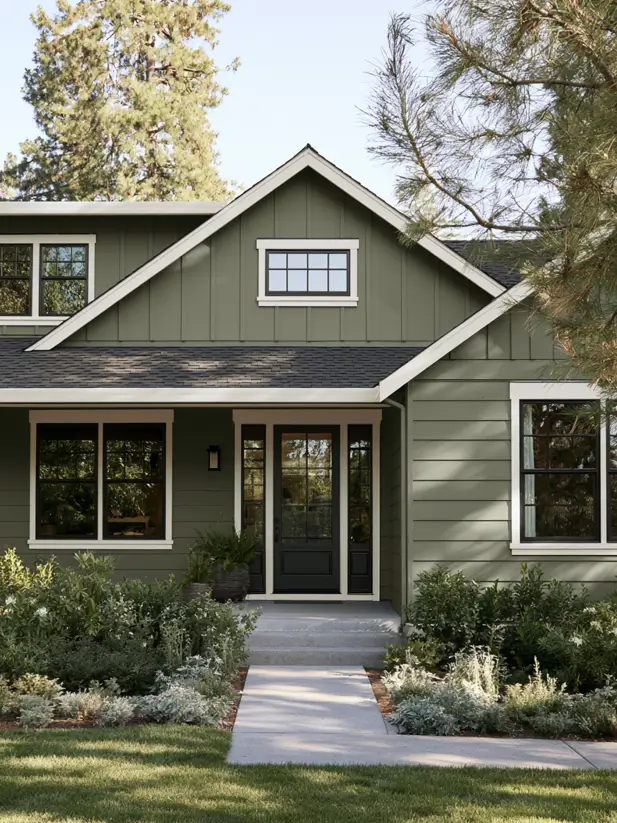
The vertical battens on this gable draw the eye upward and make the whole elevation feel taller. That’s board-and-batten’s trick, and in a deep olive-sage it swaps farmhouse-rustic for something more architectural. The black window frames and near-black door sharpen it further. If you’re running this on timber, budget for fibre-cement instead — it holds a dark green far longer in strong sun.
3. Let a charcoal roof anchor the green
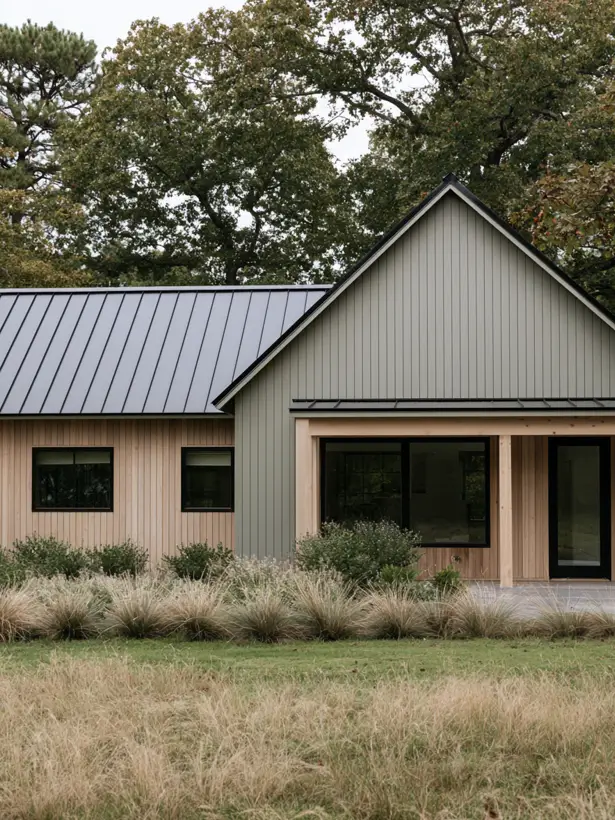
The dark standing-seam roof does the heavy lifting here: it grounds the olive-sage gable so the green reads deliberate, not washed out. Pairing it with natural cedar keeps the whole thing warm rather than cold. If you’re re-roofing anyway, a charcoal metal or shingle is the safest partner for any sage — it flatters almost every green in the family.
4. Ground sage on a stone base
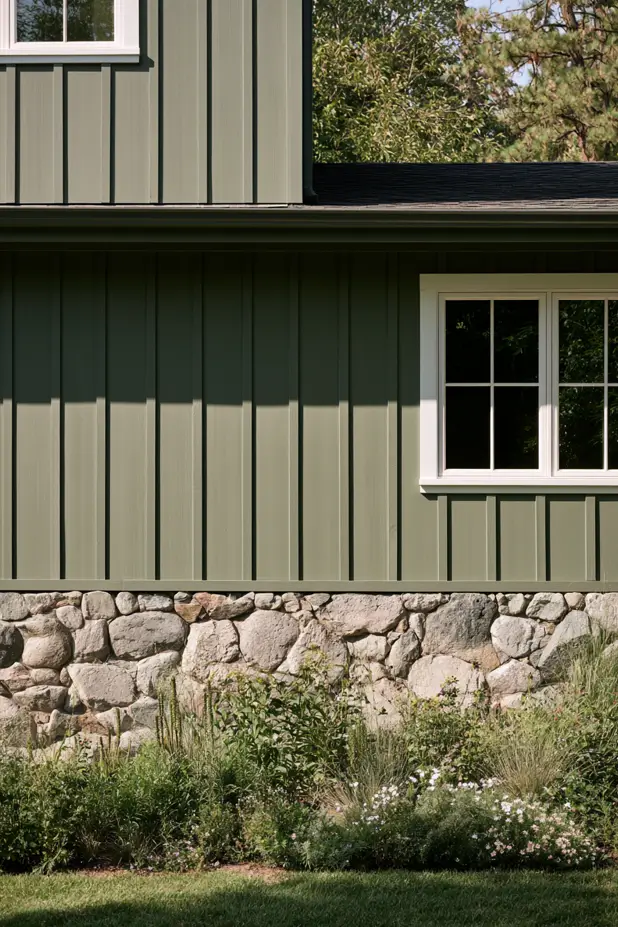
Sage can float if nothing anchors it — a rough fieldstone base fixes that, handing the green a heavy, rooted footing the eye trusts. The grey and buff tones in the stone echo the sage’s own grey undertone, so they sit together naturally. Bring a loose rock to the paint shop and sample against it; stone shifts wildly, and the green has to answer the stone, not the swatch.
5. Push sage dark and modern
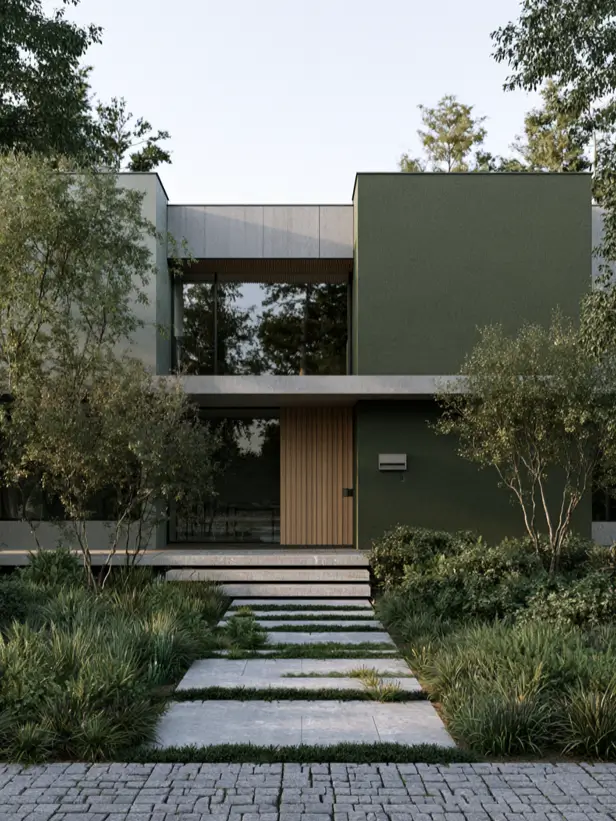
Sage doesn’t have to read cottage. Pushed this dark and dropped onto smooth render, it turns architectural — a deep forest-green that reads as a considered material, not a nostalgic one. The trick is restraint: go near-monochrome, let a single warm-wood door break the green, and skip contrasting trim entirely so the volume stays clean. Reserve this depth for large, simple facades; on a small house it closes in.
6. Let sage soften a textured cottage
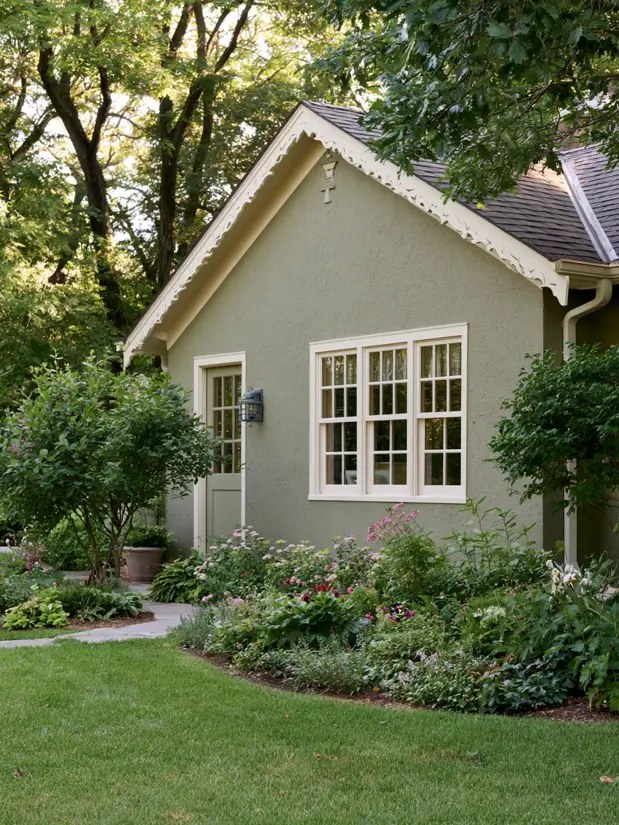
Stucco changes how sage behaves: the rough surface throws tiny shadows that shift as the sun moves, so the green looks lighter and chalkier than the same colour on flat siding. On a detailed cottage like this, that softness suits the fretwork gable and the cream trim tying it together. Match your trim to a warm cream, not stark white — bright white would fight the stucco’s warmth.
7. Dress a craftsman in deep olive
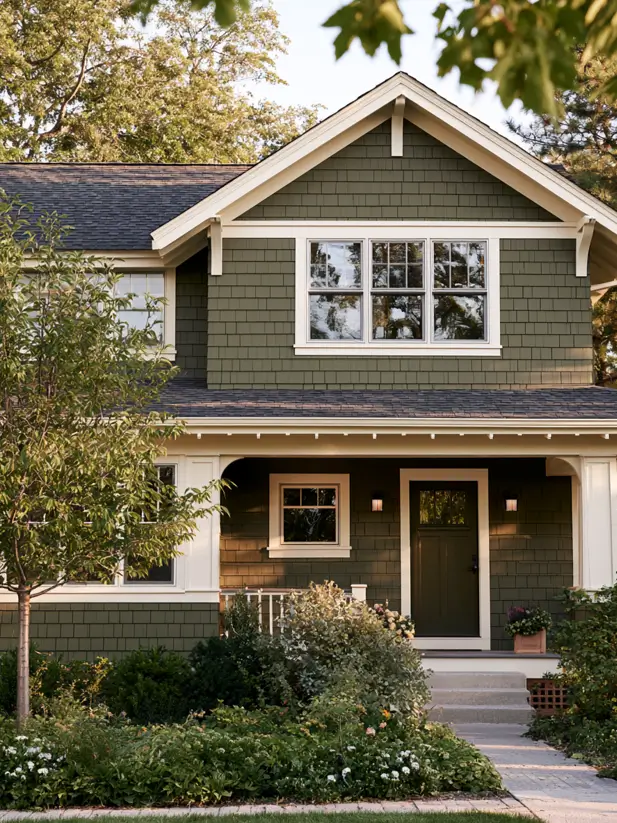
Shingle courses cast a fine horizontal shadow-line that a deep olive-green makes the most of, giving a craftsman real depth up close. Cream trim on the brackets, gable and porch posts keeps the weight from turning gloomy, and the near-black door anchors the entry. It’s the classic craftsman palette — earthy body, pale trim, dark door — and it flatters the style’s carpentry rather than hiding it.
8. Sharpen sage with black trim
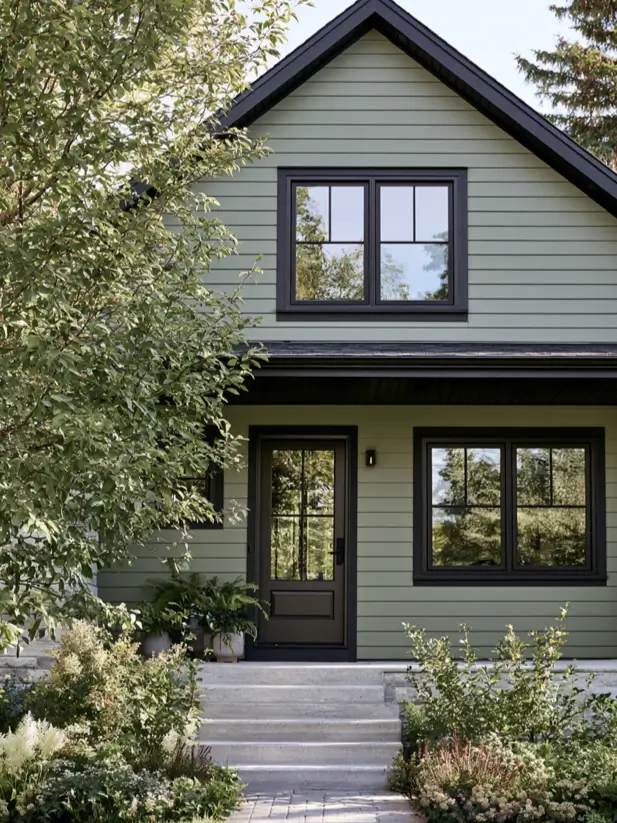
Black trim does the opposite of cream: instead of softening the sage, it snaps the whole facade into clean lines and hands it a modern-farmhouse edge. The move works because the light body gives the black something to frame against. One climate note — black window frames on a hot, sunny elevation run warmer and fade sooner, so specify a fade-rated exterior black rather than a bargain one.
9. Give the door a job with wood
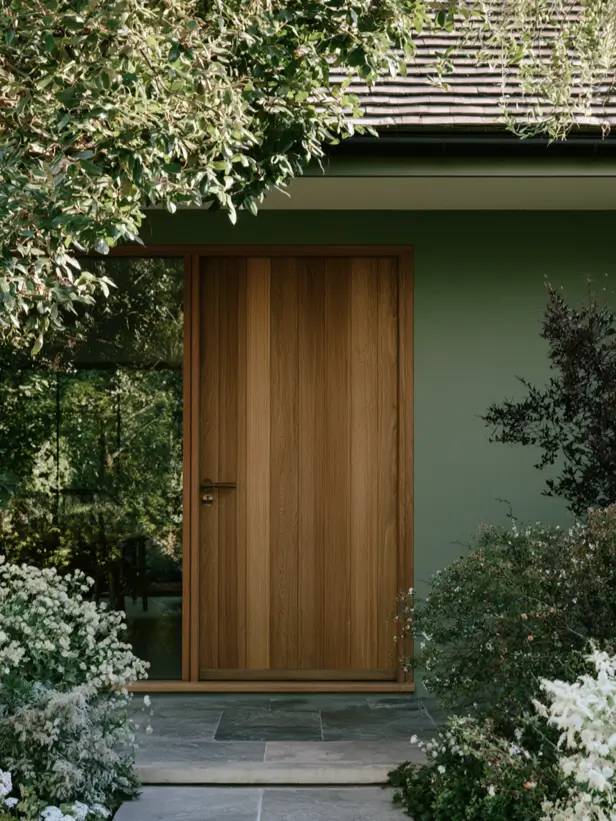
A sage house wants a door that disagrees with it, and warm wood is the surest way to do that: the honeyed oak stops the green feeling one-note and gives the eye a clear destination. Skip a stain that’s too orange — it’ll pull against the green’s cool side. Keep the grain sealed with a matte marine varnish, which holds up far better than a glossy finish in damp, shaded entryways.
10. Let copper age into your accent
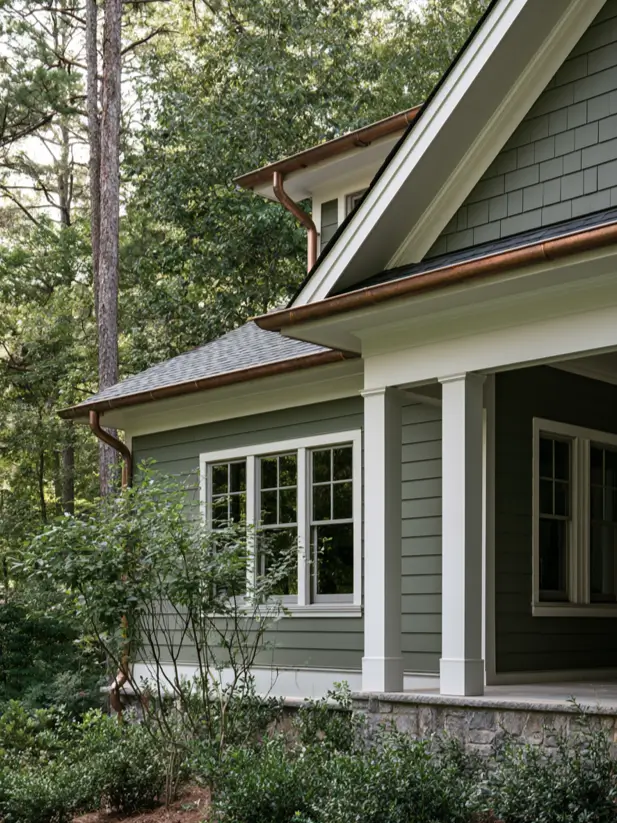
Fresh copper starts bright as a penny, then oxidises over five to ten years to a blue-green patina that lands remarkably near sage’s own register — an accent that improves while you do nothing. It’s a detail for people staying put. Can’t wait a decade? Pre-patinated copper or bronze-anodised aluminium gets you close for less, at roughly a third the cost of real copper.
11. Layer green on green at the door
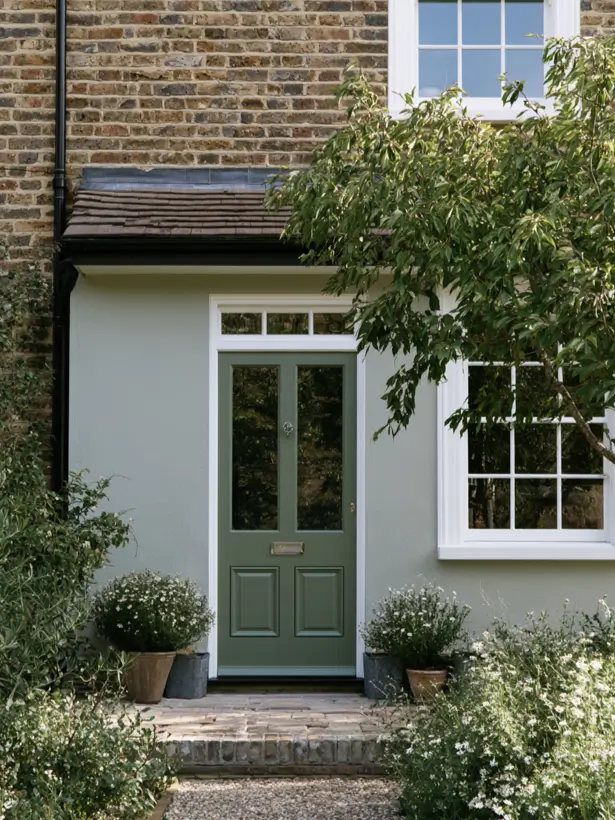
Contrast isn’t the only way to treat a sage door — going tonal works too, if you shift the value hard enough. Here a saturated olive door sits two or three steps deeper than the chalky sage render, so they read as one deliberate family rather than a near-miss. The trick is the gap: too close and it looks like you missed the tin. Crisp white round the frame keeps the two greens legible.
12. Balance white trim with black windows
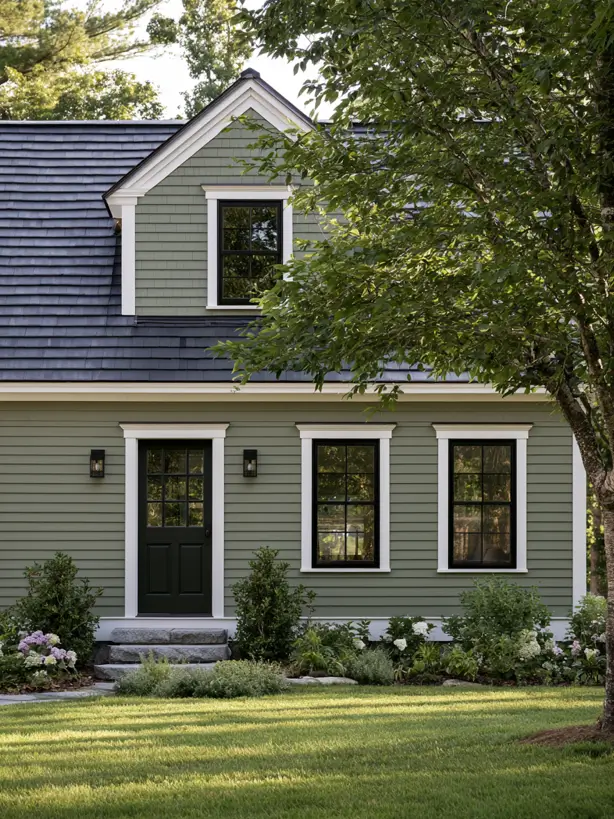
Three trim colours share this facade without clashing, and the order matters: white casings frame the openings, black sashes add the crispness, and a near-black green door anchors the entry. Keep the body a calm mid-sage so it can carry all three. Match the door to the window sashes rather than inventing a fourth colour — restraint is what stops a three-trim facade tipping into busy.
13. Calm warm brick with a paler sage
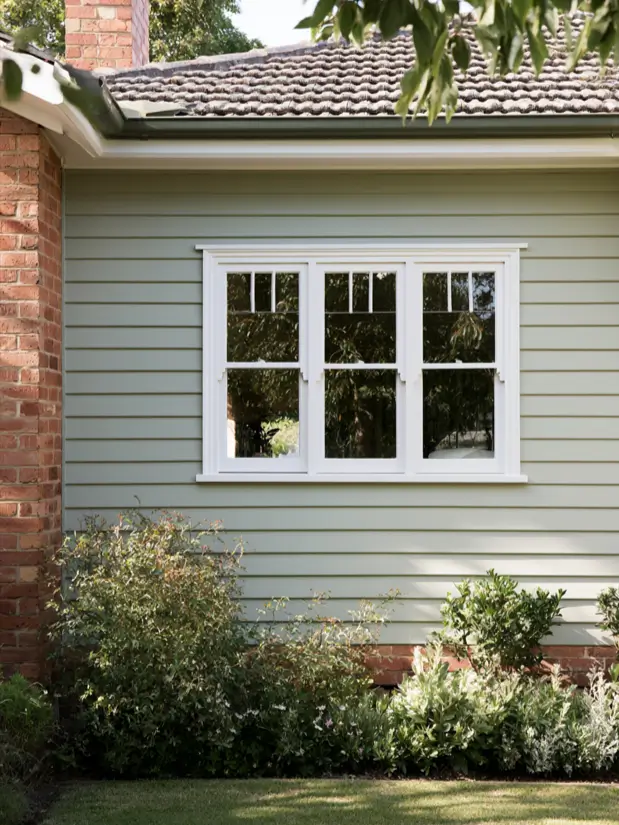
Warm red brick can shout, and sage is one of the few sidings that quiets it — green sits opposite red on the wheel, so the two cool each other down instead of competing. Keep the sage pale and grey here, not deep; a dark olive would darken the whole corner and let the brick win. Crisp white around the window stops the pairing going muddy where the two materials meet.
14. Keep modern sage light and mono-pitch clean
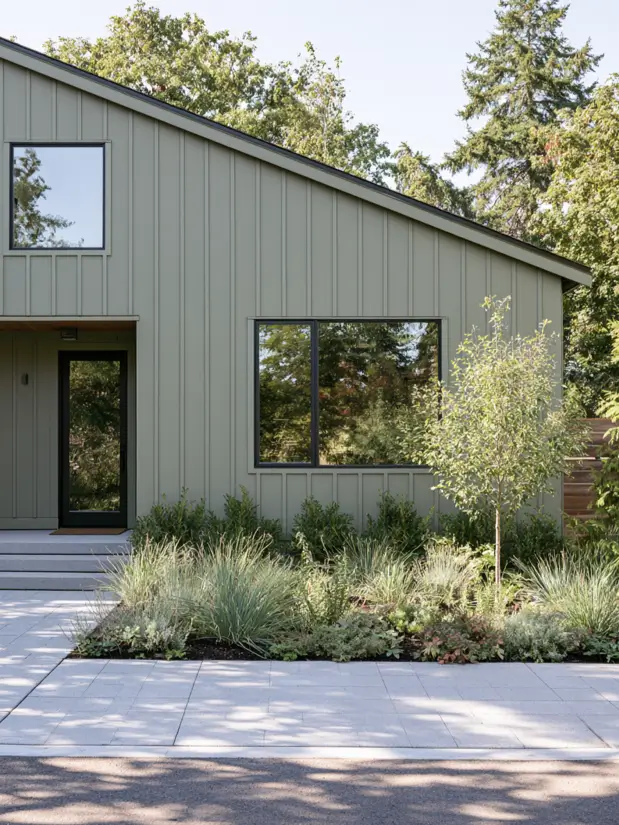
Sage suits a contemporary house if you hold the discipline: a mid grey-green, black window frames, no contrasting trim, and let the single sloping roofline do the drama. The board-and-batten runs vertical to lift the wall, and the flush black glazing keeps it crisp. This is the restrained cousin of the dark-render look — easier to live with, and far more forgiving on a smaller facade.
15. Colour-block a farmhouse gable in sage
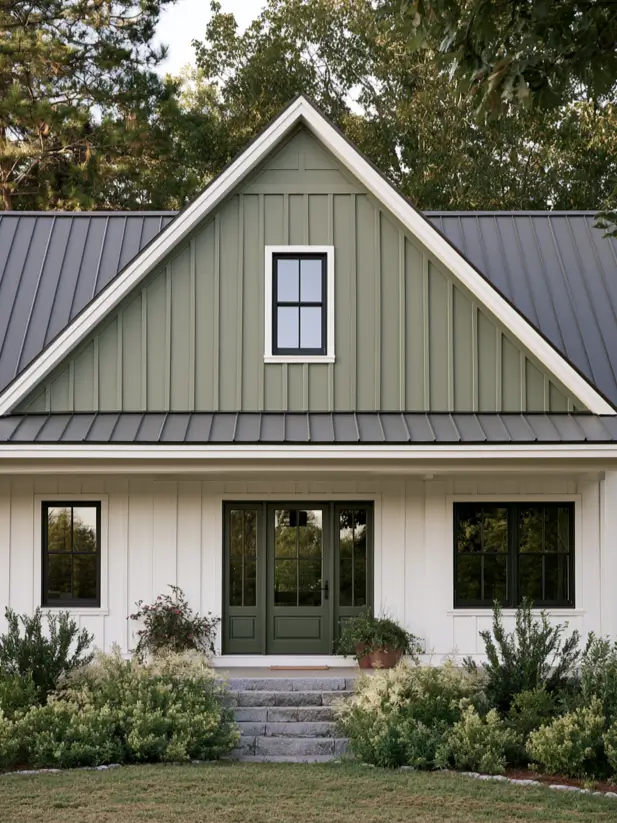
Two-tone is the modern farmhouse’s signature move, and sage up top over white below keeps it from reading stark. The black windows thread through both colours so the split looks intentional, not accidental, and the deep green door closes the loop. Run the sage on the gable and dormers only — take it lower and you lose the crisp horizon line the roof gives you.
16. Run sage low across a ranch
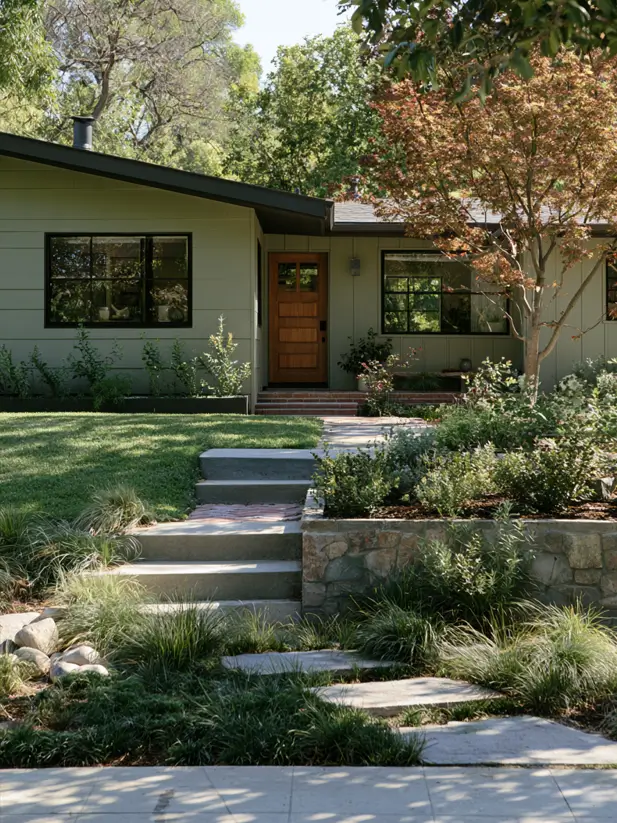
The long, low modern ranch is sage’s easiest canvas: the horizontal siding and deep overhanging eave already do the work, so a pale grey-sage just settles into them.. Keep the trim minimal and let one warm-wood door break the run — a busy palette fights the calm the roofline sets up. Black windows add just enough edge to stop it reading dated.
17. Warm olive with a red front door
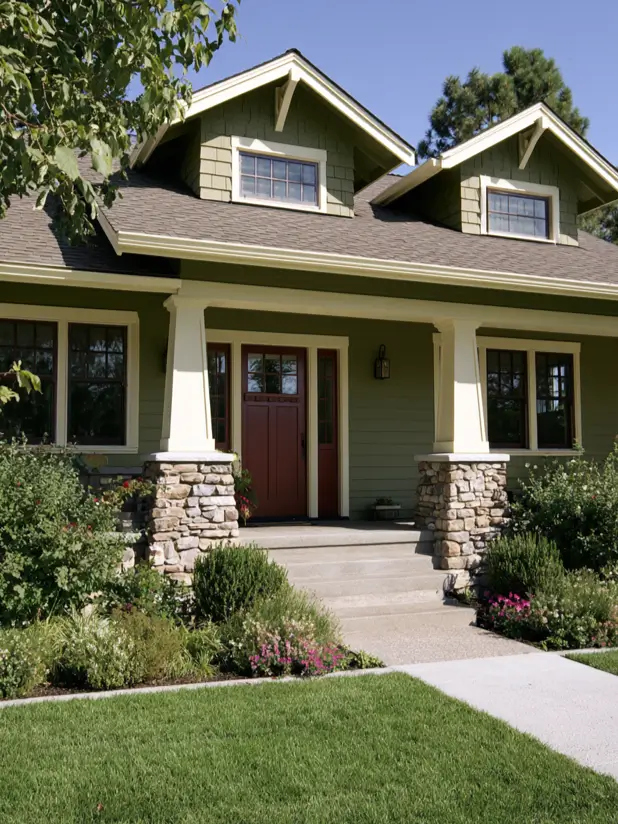
Red sits opposite green on the wheel, so a terracotta door doesn’t clash with olive siding — it completes it, pulling the eye straight to the entry. The trick is a brick-red or barn-red with warmth in it, not a pure pillar-box red, which would fight the green’s earthiness. Cream trim and stone piers keep the contrast from turning loud.
What it costs to paint a sage exterior
A professional exterior repaint runs about $3,000 to $8,000 for a typical two-storey home in 2026 — roughly $1.50 to $4.50 per square foot of siding, with a colour change usually needing two coats. Paint is only 15–20% of that; prep and labour are the rest, so cheap paint is a false economy on a job this size.
Where a deep sage costs you is longevity. The darker the green, the harder it works under sun, so it rewards a premium exterior line — Sherwin-Williams Emerald or Duration over entry-level A-100. Budget paint can chalk in a few years; a premium coat holds its colour past a decade.
Two finishing calls settle the rest: a low-sheen satin on the body and semi-gloss on the door, and — in humid climates — a paint with a mildewcide, so shaded north-facing walls don’t grow algae.
FAQ
Is sage green still in style for house exteriors in 2026?
Yes — more than ever. The 2026 colour forecasts lean hard into nature-drawn greens, and sage sits at the safe, neutral end of that shift, so it dates far slower than the cool greys it’s replacing. Pick a version with real green in it, not the greyest “greige-sage,” and it’ll still look right in ten years.
What’s the best sage green exterior paint colour?
There’s no single winner, but a few earn their reputation. Sherwin-Williams Evergreen Fog (LRV ~30) is the crowd favourite for a balanced mid-sage, Saybrook Sage leans warmer and older, and Pewter Green goes deep and dramatic. Sample two or three on your own wall — the best one is whichever suits your light and roof.
What colours go with a sage green house?
White or cream trim, a charcoal roof, and natural wood are sage’s core partners. From there, black adds a modern edge, and navy or brick-red make a confident front door. Keep the whole palette to three or four colours — sage is forgiving, but a busy facade undoes it.
What colour front door suits a sage green house?
Contrast beats matching. Natural stained wood is the easiest win, followed by matte black for modern homes and deep navy for something classic; a warm coral or mustard pops if you want colour. Avoid a door that’s simply a lighter or darker green — it reads like an accident, not a decision.
What sheen should I use for exterior sage green?
Use a low-sheen satin on the body — it hides siding flaws and keeps a modern, non-shiny finish — and semi-gloss on the door and shutters for durability. In humid climates, choose a scrubbable satin over dead-flat, because you’ll be washing algae off the shaded walls.
Does sage green exterior paint fade or show dirt?
Any mid or dark exterior colour fades faster than a pale one under strong UV, so a quality paint and a fibre-cement substrate both help in harsh sun. In humid climates, sage’s real enemy is algae on shaded walls — pick a paint with a mildewcide and wash the north side once a year. Mid-tone sages hide both fading and staining better than very pale ones.
Does a sage green exterior add value at resale?
Curb appeal genuinely moves the needle, and a well-executed repaint is among the higher-return exterior updates — but the colour has to fit the market. A broadly-liked, neutral-leaning sage is a safe bet in most neighbourhoods; a very dark or unusual green can narrow your buyers on a traditional street. Painting to sell, lean mid-tone and conventional; staying put, paint the green you love. Local comparable sales tell you more than any trend.
Conclusion
If you take one thing from all of this, make it the sample board. Sage rewards the people who test it against their own roof, brick and light, and it punishes the ones who trust a chip under shop lighting. Buy three greens, paint them big, and look at them at breakfast and at dusk before you commit a penny to the whole house. Get the shade right and every other decision here gets easier — the rest of the palette lives in our complete 2026 exterior paint guide. Save this guide for when the samples are drying.